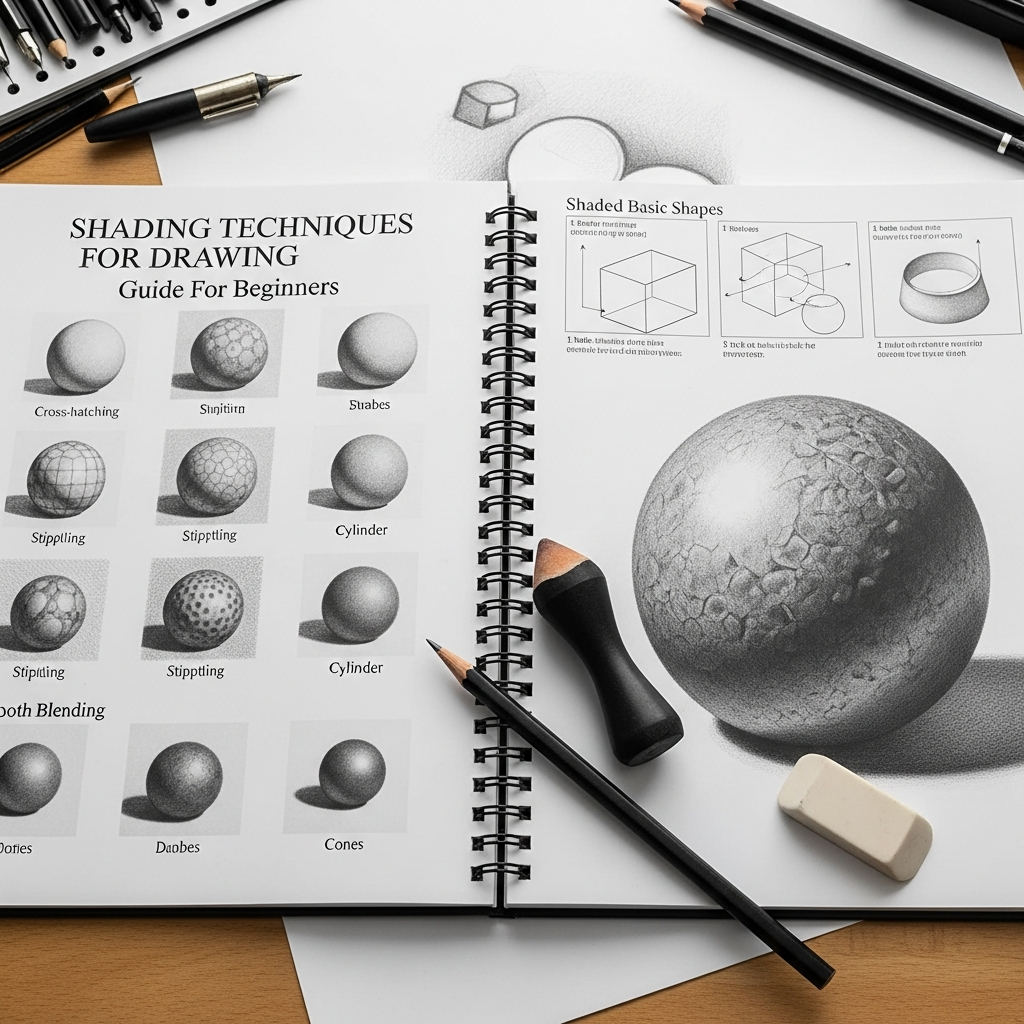
Shading Techniques for Drawing: The Ultimate Guide for Beginners
Shading is the transformative element that elevates a simple line drawing into a realistic, three-dimensional masterpiece. For many aspiring artists, the transition from sketching outlines to creating depth can feel daunting. However, mastering shading techniques for drawing is not about innate talent; it is about understanding the physics of light and developing muscle memory through consistent practice.
In this comprehensive guide, you will explore the foundational principles of light, the essential tools required, and the specific pencil shading types that professional artists use to create life-like textures. Whether you are drawing a simple sphere or a complex portrait, these techniques will provide the framework you need to succeed.
Understanding the Science of Light and Shadow
Before you pick up a pencil, you must understand how light interacts with physical objects. Without a clear light source in drawing, your shading will appear inconsistent and confusing to the viewer’s eye. Every 3D object hit by light creates a predictable pattern of values.
The Five Key Elements of Shading
- Highlight: The area where the light source hits the object directly. This is usually the brightest part of your drawing.
- Mid-tones (Halftones): The actual color or value of the object, unaffected by direct highlights or deep shadows.
- Core Shadow: The darkest area on the object itself, occurring where the surface turns away from the light.
- Reflected Light: A subtle light area within the shadow, caused by light bouncing off the ground or surrounding surfaces back onto the object.
- Cast Shadow: The dark shape created on the surface the object is sitting on, opposite the light source.
By identifying these five elements, you can create a sense of volume. Beginners often make the mistake of ignoring reflected light, which results in drawings that look flat or “cut out” from the background. Always remember that shadows are rarely a solid block of black; they contain nuances that define the object’s form.
Essential Tools for Mastering Shading
While you can start with a standard school pencil, having the right graphite pencils for shading will significantly improve your results. Pencils are graded on a scale of “H” (Hard) to “B” (Black/Soft).
The Graphite Scale
For effective shading techniques for drawing, you should ideally have a range of pencils:
- H Pencils (2H, 4H): These produce light, fine lines. They are perfect for initial sketches and very light highlights.
- HB Pencil: The middle ground, similar to a standard #2 pencil.
- B Pencils (2B, 4B, 6B, 8B): These are softer and darker. A 4B or 6B is essential for deep core shadows and cast shadows.
Additional Must-Have Supplies
- Kneaded Eraser: Unlike hard rubber erasers, these can be molded into points to “lift” graphite and create highlights or clean up edges.
- Blending Stumps (Tortillions): Rolled paper tools used for the blending techniques that create smooth, skin-like textures.
- High-Quality Drawing Paper: Paper with a slight “tooth” or texture helps catch the graphite, allowing for richer darks and smoother transitions.
The Value Scale: The Backbone of Realistic Shading
A value scale is a tool used by artists to measure the range of lightness to darkness. Most professional artists work with a 9-step or 12-step scale, ranging from pure white to deep black. Mastering the value scale is one of the most important drawing shading basics.
You should practice creating a value scale by drawing a long rectangle divided into nine squares. Leave the first square white, make the last square as dark as your softest pencil allows, and fill in the middle squares with gradual transitions. This exercise trains your hand to control pencil pressure, which is the secret to smooth shading.
Pro Tip: Many beginners are “afraid of the dark.” They stop at a medium grey, fearing that darker values will ruin the drawing. Do not hesitate to use your 6B or 8B pencils to achieve high contrast; contrast is what makes a drawing “pop.”
Core Shading Techniques Every Beginner Should Know
There are several distinct ways to apply graphite to paper. Each technique offers a different texture and “feel” to the final artwork. Understanding these pencil shading types will allow you to choose the best method for your specific subject.
1. Hatching
Hatching involves drawing a series of parallel lines. The closer the lines are together, the darker the area appears. This technique is excellent for architectural drawings or when you want to show a clear direction of light. Ensure your lines follow the contour of the object to reinforce its 3D shape.
2. Cross-Hatching
Cross-hatching is an extension of hatching where you layer sets of parallel lines at different angles (usually perpendicular or diagonal). This builds up deep values quickly and adds a sophisticated, textured look to your work. It is a staple in pen and ink drawings but works beautifully with graphite as well.
3. Blending (Smooth Shading)
This is perhaps the most popular technique for realistic shading tips. You apply graphite to the paper and then use a blending stump, tissue, or even a clean finger (though fingers contain oils that can ruin the paper) to smudge the graphite into a seamless gradient. This is ideal for rendering smooth surfaces like glass, metal, or human skin.
4. Stippling
Stippling is the process of creating a drawing using only small dots. The density of the dots determines the value. While time-consuming, stippling offers incredible control over subtle transitions and creates a unique, artistic aesthetic often seen in botanical or scientific illustrations.
5. Scumbling (Circulism)
Scumbling involves moving your pencil in small, tight, circular motions. The layers overlap to create a soft, textured finish. Many portrait artists use scumbling to replicate the natural texture of skin pores. It is also an excellent way to build up dark values without leaving harsh line marks.
Step-by-Step Guide: How to Shade a Sphere
To apply these shading techniques for drawing guide for beginners, let’s practice on a classic sphere. This exercise incorporates all the elements of light and shadow mentioned earlier.
Step 1: Outline and Light Source
Draw a clean circle using an HB pencil. Decide where your light is coming from (e.g., the top-left corner). Lightly mark the area where the highlight will be.
Step 2: Map the Shadows
Lightly sketch the boundary for the core shadow and the cast shadow on the ground. This creates a “roadmap” for your shading so you don’t get lost in the process.
Step 3: Apply the Mid-tones
Using a 2B pencil, begin filling in the area around the highlight using the scumbling or hatching technique. Keep your pressure very light as you move toward the highlight and slightly heavier as you move toward the shadow side.
Step 4: Build the Core Shadow
Switch to a 4B or 6B pencil. Darken the core shadow—the area where the sphere turns away from the light. Remember to leave a small gap of lighter value at the very edge of the sphere for the reflected light.
Step 5: Create the Cast Shadow
The cast shadow is usually the darkest part of the drawing, especially right where the object touches the surface (the occlusion shadow). Use your darkest pencil to fill this in, making the edges slightly softer as they move away from the sphere.
Step 6: Blend and Refine
Use a blending stump to smooth out the transitions between the mid-tones and shadows. If you accidentally darkened the highlight, use your kneaded eraser to dab the area and lift the graphite back to white.
Advanced Tips for Realistic Shading
Once you are comfortable with the basics, use these expert tips to take your art to the next level:
- Avoid Smudging with Your Hand: Place a clean sheet of paper under your drawing hand. This prevents your palm from smearing the graphite you have already meticulously applied.
- Observe “Lost and Found” Edges: In areas where the object’s value matches the background value, the edge might disappear. This is called a “lost edge” and it adds a professional, painterly quality to your sketches.
- Sharpen Your Pencils Frequently: Even for shading, a sharp point allows you to get graphite into the “valleys” of the paper’s texture, resulting in a more solid and rich dark value.
- Work from Light to Dark: It is much easier to add more graphite than it is to remove it. Start with your H pencils and gradually layer your B pencils.
- Understand “Tooth”: If the paper becomes “shiny,” you have flattened the tooth of the paper. This happens when you press too hard. Layering slowly is better than pressing hard in one go.
Common Mistakes Beginners Make
Even with a shading techniques for drawing guide, beginners often fall into these common traps:
- Outlining Everything: Real objects don’t have black outlines; they have edges defined by differences in value. Try to let your shading define the shape rather than a hard line.
- Uniform Shadows: Making the entire shadow side one single color. Remember the core shadow vs. reflected light.
- Dirty Blending: Using a blending stump that is covered in old, dark graphite for a light area. Keep your tools clean by rubbing them on sandpaper.
- Ignoring the Background: An object exists in a space. Shading the background (even slightly) can help the highlights of your subject stand out more effectively.
Conclusion: Practice Makes Perfect
Mastering shading techniques for drawing is a journey of observation. The more you look at the world around you—noticing how shadows fall on a coffee mug or how light filters through a leaf—the better your drawings will become. Start with simple shapes, focus on your value scale, and experiment with different pencil shading types.
Do not be discouraged if your first few attempts look messy. Shading is a technical skill that rewards patience and repetition. By following this guide, you have the foundational knowledge to turn flat sketches into immersive, three-dimensional art. Grab your pencils, find a light source, and start creating today!
Frequently Asked Questions (FAQ)
What is the best pencil for shading for a beginner?
For a beginner, a 2B or 4B pencil is the most versatile. These pencils are soft enough to create dark shadows but can still be used for lighter mid-tones with a light touch. A small set containing 2H, HB, 2B, 4B, and 6B is ideal for most projects.
How do I stop my shading from looking “scratchy”?
Scratchy shading is often caused by using a pencil that is too hard or by pressing too hard. To get a smooth finish, use circular motions (scumbling) and build up the layers slowly. Using a blending stump or tissue can also help smooth out the pencil marks.
Is it better to shade with a pencil or a blending stump?
You should always apply the graphite with a pencil first. The blending stump is a secondary tool used to move and smooth the graphite that is already on the paper. Relying solely on a stump can lead to “muddy” drawings that lack definition.
How do I know where to put the shadows?
Everything depends on the light source. Imagine a lamp or the sun shining on your object. The side facing the light will be light, and the side facing away will be dark. Shadows always fall on the opposite side of the light source.
Can I use my finger to blend?
While many beginners use their fingers, it is generally discouraged. The natural oils on your skin can transfer to the paper, making the graphite stick in ways that are hard to erase or blend later. It can also cause the paper to yellow over time. Using a tissue or blending stump is a much more professional approach.