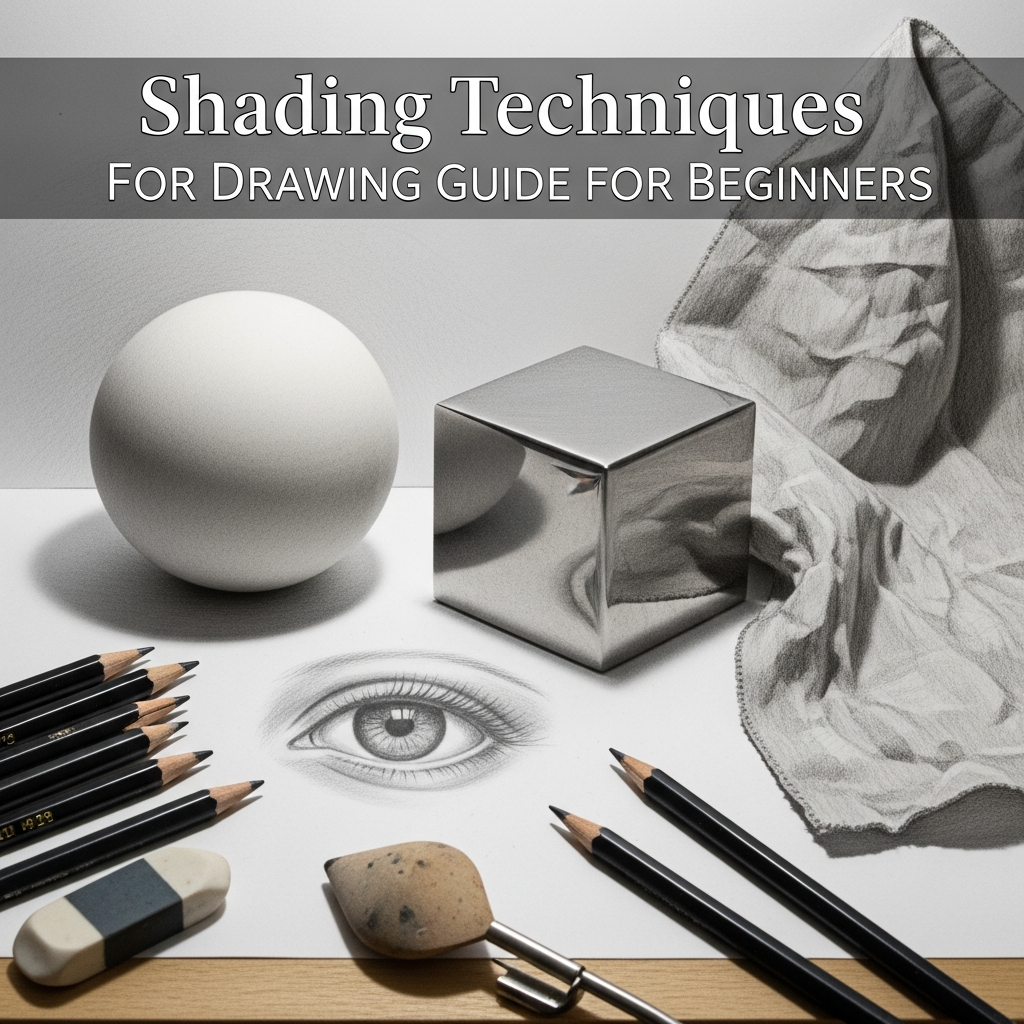
Master Shading: A Comprehensive Guide to Shading Techniques for Drawing for Beginners
Shading is the magical bridge that transforms a flat, two-dimensional sketch into a vivid, three-dimensional masterpiece. Without the proper application of light and shadow, even the most accurately proportioned drawing will appear lifeless and “flat.” If you have ever wondered how professional artists make their subjects leap off the page, the answer lies in their mastery of shading techniques for drawing.
In this extensive guide, you will explore the fundamental principles of light, the essential tools required, and a deep dive into various methods that will elevate your artistic skills. Whether you are picking up a pencil for the first time or looking to refine your existing abilities, this pillar content is designed to be your ultimate resource.
1. Understanding the Fundamentals of Light and Shadow
Before you touch your pencil to paper, you must understand how light interacts with physical objects. Shading is not just about making parts of a drawing darker; it is about describing the form and volume of an object through the manipulation of “values.”
The Anatomy of a Shadow
To master shading techniques for drawing, you must recognize the five key areas of light and shadow:
- The Highlight: This is the point where the light source hits the object directly. It is the brightest part of your drawing and often requires leaving the paper white.
- The Midtone (Halftone): This is the actual color or value of the object without the direct influence of intense light or deep shadow. It transitions the highlight into the darker areas.
- The Core Shadow: This is the darkest area on the object itself, where the light source cannot reach. It defines the shape of the object.
- Reflected Light: A common mistake beginners make is forgetting reflected light. This is light that bounces off the surface the object is sitting on and hits the dark side of the object. It is subtle but crucial for realism.
- The Cast Shadow: This is the shadow thrown by the object onto the surrounding surface. It is usually darkest right where the object touches the surface (the occlusion shadow).
Determining the Light Source
Every successful drawing begins with a consistent light source. Before you begin pencil shading, decide where your light is coming from (e.g., top-left, directly above, or from the side). You may even find it helpful to draw a small sun or arrow in the corner of your page as a reminder.
2. Essential Tools for Professional Shading
While you can start with a standard school pencil, having the right equipment will significantly improve your results. The quality of your graphite pencils and paper determines how well the lead adheres and blends.
Graphite Pencil Grades
Pencils are graded on a scale of “H” (Hard) to “B” (Black/Soft):
- H Series (9H to H): These pencils have hard lead and produce light, fine lines. They are excellent for initial outlines but difficult to shade with.
- HB Pencil: The middle ground. Great for general sketching.
- B Series (B to 9B): These are the “shading pencils.” They have softer lead that produces darker, richer blacks. A 2B, 4B, and 6B are essential for any beginner’s kit.
Erasers and Blending Tools
- Kneaded Eraser: Unlike hard rubber erasers, a kneaded eraser can be molded into points to “pick up” graphite and create highlights without damaging the paper.
- Blending Stumps (Tortillions): These are tightly rolled paper sticks used to smudge and smooth out graphite for a seamless look.
- Tissue or Chamois: Used for blending large areas of a drawing to create a soft, atmospheric effect.
3. The 7 Essential Shading Techniques for Drawing
There is no “single” way to shade. Different shading techniques for drawing produce different textures and moods. Here are the seven methods every beginner should practice.
A. Hatching
Hatching is the most basic form of shading. It involves drawing a series of parallel lines. The closer the lines are to each other, the darker the area appears.
- Best for: Quick sketches, architectural drawings, and creating a sense of direction.
- Pro Tip: Keep your pressure consistent to ensure the lines look intentional.
B. Cross-Hatching
Cross-hatching takes the hatching technique a step further by layering a second set of parallel lines in the opposite direction (crossing the first set).
- Best for: Creating deep shadows and adding a rich, woven texture to your work.
- Pro Tip: You can add third or fourth layers at different angles to create even denser “blacks.”
C. Stippling (Pointillism)
Stippling involves creating a pattern of dots. Darker areas are achieved by placing dots very close together, while lighter areas have more space between the dots.
- Best for: Creating unique textures and high-contrast images.
- Warning: This is a time-consuming technique that requires immense patience, but the results are often stunningly detailed.
D. Blending (Smoothing)
Blending involves applying graphite to the paper and then using a tool (like a blending stump, tissue, or your finger) to smear the graphite into a smooth, continuous gradient.
- Best for: Realistic portraits, smooth skin textures, and polished still-life drawings.
- Pro Tip: Avoid using your bare finger, as the natural oils on your skin can stain the paper and make the shading look “muddy” or uneven over time.
E. Circulism (Scribbling)
Circulism involves drawing tiny, overlapping circles or “scribbles.” By building up these layers, you create a soft, grainy texture.
- Best for: Drawing skin textures, fuzzy fabrics, or natural elements like stone.
- Pro Tip: Use a very sharp pencil for fine textures and a blunt pencil for broader, softer textures.
F. Contour Shading
In contour shading, your lines follow the shape or “contour” of the object. For example, if you are shading a sphere, your lines should be curved to mimic the roundness of the ball.
- Best for: Adding volume and making objects look three-dimensional.
- Pro Tip: This technique is often combined with hatching (Contour Hatching).
G. Scumbling
Scumbling is similar to scribbling but is often done with a very light touch and a blunt pencil. It creates a “smoky” or “hazy” effect.
- Best for: Backgrounds, clouds, or adding a layer of atmosphere to a scene.
4. Understanding the Value Scale: The Secret to Depth
A value scale is a tool used by artists to measure the range of lightness to darkness. To create a professional-looking drawing, you need a wide “value range.”
Many beginners are afraid to go dark. They stay in the “middle gray” zone, which results in a flat drawing. To overcome this:
- Create a 5-Step Scale: Draw five squares. Leave the first white. Make the last as dark as your pencil allows. Fill the middle three with graduating shades of gray.
- Compare Your Drawing: Hold your value scale up to your drawing. Do you have a true black? Do you have a crisp white? If your drawing only uses steps 2, 3, and 4, it will lack impact.
5. Step-by-Step Guide: Shading Your First Sphere
Let’s put these shading techniques for drawing into practice. A sphere is the perfect subject for beginners because it incorporates every element of light and shadow.
Step 1: Draw the Outline
Draw a clean circle using an HB pencil. Keep the lines light so they can be easily adjusted or erased.
Step 2: Identify the Light Source
Imagine a light coming from the top-right. Mark a small circle on the top-right of your sphere; this will be your Highlight.
Step 3: Map the Shadows
Lightly outline the area where the Core Shadow will be (the side furthest from the light) and the Cast Shadow on the ground.
Step 4: Apply the Midtones
Using a 2B pencil, start filling in the area between the highlight and the core shadow. Use the Circulism or Blending technique for a smooth transition.
Step 5: Deepen the Core Shadow
Switch to a 4B or 6B pencil. Darken the core shadow area. Remember to leave a small sliver of Reflected Light at the very edge of the sphere, just before the cast shadow begins.
Step 6: Create the Cast Shadow
The cast shadow is darkest where the sphere touches the ground. As it moves away from the sphere, it should become lighter and slightly more blurred.
Step 7: Refine and Blend
Use your kneaded eraser to clean up the highlight. Use a blending stump to smooth out any harsh transitions between the midtones and the shadows.
6. Common Shading Mistakes to Avoid
Even with the best drawing guide for beginners, pitfalls are common. Here is what to watch out for:
- The “Outline” Trap: In the real world, objects don’t have black outlines; they have edges defined by different values. Try to blend your outlines into your shading so they disappear.
- Over-Blending: If you blend too much, your drawing will look “mushy” or blurry. Maintain some crisp edges to give the eye a place to rest.
- Dirty Paper: Graphite smudges easily. Use a piece of scrap paper under your hand to prevent your palm from smearing your finished work.
- Ignoring the Eraser: Remember that an eraser is a drawing tool, not just a correction tool. Use it to “draw” light back into your work.
7. Expert Tips to Accelerate Your Progress
- Squint Your Eyes: When looking at your reference photo or subject, squint. This reduces the detail and allows you to see the broad shapes of light and dark more clearly.
- Practice Every Day: Shading is about muscle memory. Spend 15 minutes a day drawing simple shapes (cubes, cylinders, spheres) using different techniques.
- Study the Masters: Look at the drawings of Leonardo da Vinci or Rembrandt. Observe how they used “Chiaroscuro” (the strong contrast between light and dark) to create drama.
- Check Your Contrast: Take a photo of your drawing and turn it into a high-contrast black-and-white image on your phone. This will instantly show you if your values are strong enough.
8. Conclusion
Mastering shading techniques for drawing is a journey of observation and patience. By understanding how light behaves and practicing the various methods like hatching, stippling, and blending, you will gain the ability to create art that feels tangible and real.
Remember, every great artist started exactly where you are now. The key is to stop seeing “objects” and start seeing “values.” Grab your pencils, find a light source, and start transforming your sketches into three-dimensional wonders today.
Frequently Asked Questions (FAQ)
Q1: Which pencil is best for shading?
For beginners, a 2B or 4B pencil is ideal. They are soft enough to create dark shadows but can still be used for lighter midtones depending on the pressure you apply.
Q2: How do I stop my shading from looking messy?
Use a clean blending stump instead of your fingers, and always keep a piece of paper under your hand to prevent smudging. Also, ensure your pencils are sharp for detailed areas.
Q3: Can I use these techniques with colored pencils?
Yes! Hatching, cross-hatching, and blending are all fundamental to colored pencil art. However, blending often requires a specific colorless blender pencil or solvent.
Q4: What is the hardest shading technique to learn?
Many find stippling to be the most difficult because it requires extreme patience and a steady hand. Blending is also challenging because it is easy to “over-work” the paper.
Q5: How long does it take to master shading?
You can learn the basic concepts in a day, but mastering the nuances of texture and light can take months or years of consistent practice.