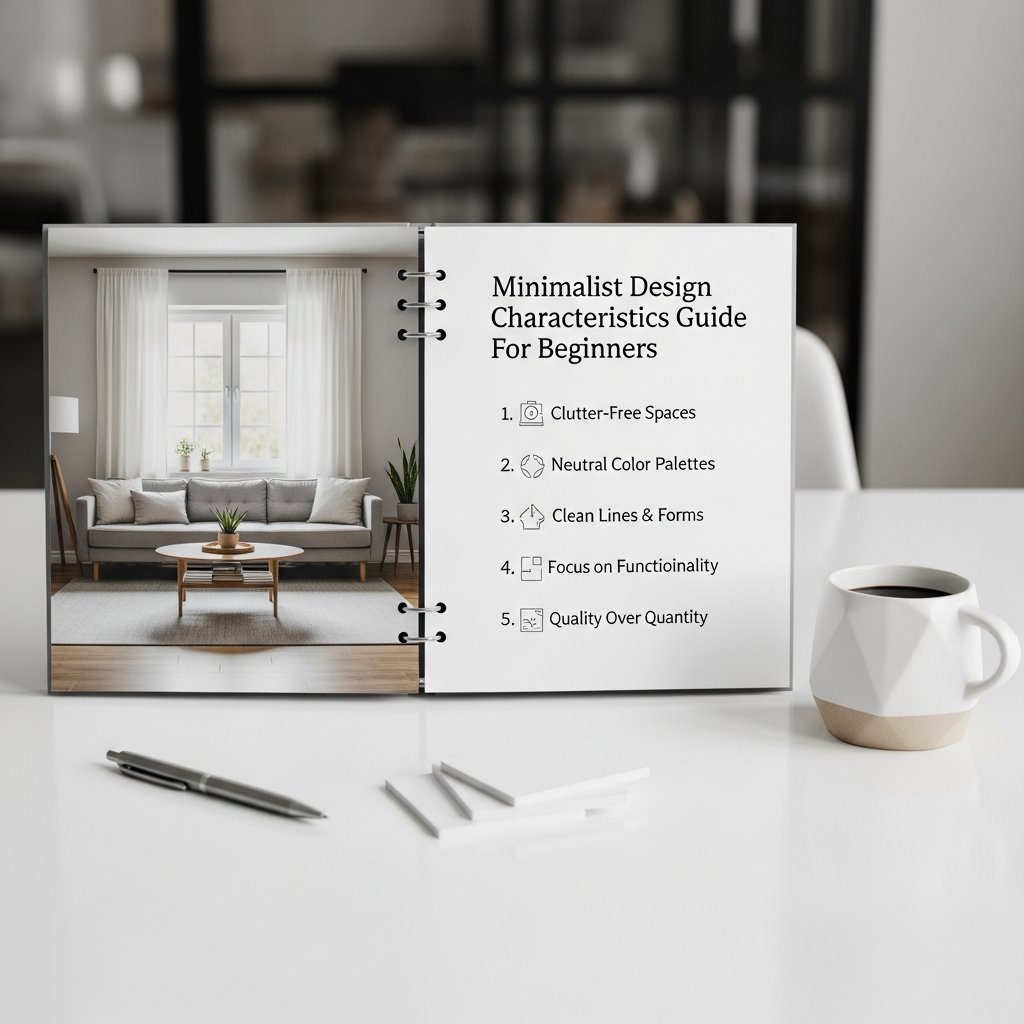
Minimalist Design Characteristics: A Comprehensive Guide for Beginners
In an era defined by information overload and constant visual noise, minimalist design has emerged as a sanctuary of clarity and purpose. Often misunderstood as merely “empty” or “boring,” minimalism is a sophisticated discipline that prioritizes essentialism over excess. If you have ever felt overwhelmed by cluttered spaces or complex websites, you have already experienced the need for minimalist principles.
This guide serves as your definitive roadmap to understanding minimalist design characteristics. Whether you are an aspiring interior designer, a digital creator, or someone looking to simplify your environment, this pillar article will provide the depth and practical steps you need to master the art of “less is more.”
What is Minimalist Design?
Minimalist design is a creative approach that strips away non-essential elements to highlight the core essence of a subject. It originated from the 20th-century art movements, heavily influenced by Japanese traditional design (Ma) and the Dutch De Stijl movement. However, it was the Bauhaus school and architects like Ludwig Mies van der Rohe who popularized the mantra “Less is More.”
At its heart, minimalism is not about removing things for the sake of emptiness; it is about providing the right things in their most potent form. By focusing on functionality and clean aesthetics, you allow the viewer or user to interact with the content or space without distraction.
The Core Philosophy: “Less is More” vs. “Better is More”
Before diving into the technical characteristics, you must understand the mindset. Minimalism is often confused with asceticism. While asceticism avoids pleasure, minimalism seeks to enhance pleasure by removing the friction caused by clutter.
In modern design circles, many experts prefer the phrase “Better is More.” This implies that every element remaining in a minimalist composition must be of the highest quality and serve a dual purpose: aesthetic beauty and functional utility.
7 Essential Minimalist Design Characteristics
To successfully implement this style, you must recognize and master these fundamental characteristics. These principles apply across various disciplines, from architecture and interior design to graphic and web development.
1. Functionalism and Purpose
In minimalist design, every object must have a reason for existing. If a piece of furniture doesn’t provide comfort or storage, or if a button on a website doesn’t lead to a vital action, it is likely unnecessary.
- Utility First: The form of an object should always follow its intended function.
- Intentionality: You must ask yourself, “Does this add value or just take up space?”
- Clarity: The purpose of the design should be immediately obvious to the observer.
2. Strategic Use of Negative Space (White Space)
Negative space, often called white space, is perhaps the most critical minimalist design characteristic. It refers to the empty areas between and around the subjects of an image or objects in a room.
- Breathing Room: Negative space prevents the eye from feeling “trapped.”
- Focus: By surrounding an object with emptiness, you naturally draw the viewer’s attention to that specific focal point.
- Luxury: In many cultures, the abundance of space is a sign of luxury and high-end curation.
3. Clean Lines and Simple Shapes
Minimalism avoids ornate decorations, complex patterns, and unnecessary flourishes. Instead, it relies on the inherent beauty of geometric forms.
- Linearity: Use of straight lines, smooth curves, and defined edges.
- Geometric Purity: Circles, squares, and rectangles form the foundation of minimalist layouts.
- Uncluttered Silhouettes: Furniture and architectural elements should have a clear, recognizable outline without “visual noise.”
4. A Limited and Monochromatic Color Palette
Color in minimalism is used with extreme restraint. You will typically see a “tonal” approach where different shades of the same color are used to create depth without chaos.
- Neutral Bases: Whites, beiges, grays, and blacks are the standard.
- Accent Colors: If a bright color is used, it is usually a single “pop” of color used to highlight a specific area or call-to-action (CTA).
- Natural Tones: Earthy colors derived from wood, stone, or clay are popular in “warm minimalism.”
5. High-Quality Natural Materials
Because there are fewer items in a minimalist space, the quality of those items becomes paramount. You cannot hide poor craftsmanship behind clutter.
- Texture Over Pattern: Instead of using a busy wallpaper, a minimalist might use a raw concrete wall or a textured linen fabric to provide visual interest.
- Longevity: Minimalist design favors materials that age gracefully, such as solid oak, marble, stainless steel, and glass.
6. Exceptional Typography and Visual Hierarchy
In digital and graphic design, typography is a central pillar. When you remove images and icons, the text must carry the weight of the brand’s personality.
- Sans-Serif Fonts: Modern, clean fonts like Helvetica, Futura, or Montserrat are staples.
- Weight Variation: Using bold and light versions of the same font to create a hierarchy.
- Readability: The primary goal is to ensure the message is conveyed instantly.
7. Balance and Symmetry
While not all minimalist design is perfectly symmetrical, it always strives for visual balance. An asymmetrical layout can still feel balanced if the weight of the elements is distributed thoughtfully across the canvas or room.
Why Choose Minimalism? The Benefits Beyond Aesthetics
Adopting minimalist design characteristics isn’t just a trend; it offers several psychological and practical advantages:
- Reduced Cognitive Load: Our brains find it easier to process simple environments. This leads to lower stress levels and increased focus.
- Ease of Maintenance: Fewer items mean less cleaning, less organizing, and fewer things to repair.
- Timelessness: Minimalist designs rarely go “out of style” because they aren’t tied to the fleeting decorative trends of a specific year.
- Sustainability: By choosing quality over quantity, you contribute to a “buy less, buy better” philosophy that reduces waste.
How to Implement Minimalist Design: A Step-by-Step Guide
If you are ready to transform your space or project, follow this systematic approach to achieving a minimalist aesthetic.
Step 1: Declutter and Identify Essentials
You cannot build a minimalist design on top of a cluttered foundation. Start by removing everything that does not serve a function or bring genuine joy.
- The “Box” Method: Put items you are unsure about in a box. If you don’t look for them in 30 days, they aren’t essential.
- Digital Audit: For web designers, look at your analytics. Remove features or pages that users rarely visit.
Step 2: Establish a Neutral Foundation
Choose your base color. In interior design, this is usually the wall color. In web design, this is the background.
- Pro Tip: Use “Off-White” instead of “Stark White” to prevent the design from feeling too clinical or cold.
Step 3: Focus on Light and Texture
Since you are limiting colors and objects, you must use light to create atmosphere.
- Natural Light: Maximize windows and open spaces.
- Layered Lighting: Use floor lamps, recessed lighting, and task lighting to create depth.
- Touchability: Introduce different textures (wool, wood, metal) to add “warmth” to the simplicity.
Step 4: Create a Focal Point
Every room or page needs a hero. This could be a large piece of art, a unique architectural feature, or a bold headline.
- Ensure the focal point has enough negative space around it to truly stand out.
Step 5: Edit and Refine
Minimalism is a process of constant editing. After you think you are finished, look again and see if there is one more thing you can remove without losing the meaning of the work.
Common Misconceptions About Minimalist Design
To master this style, you must debunk these common myths:
- “Minimalism is Cold and Unwelcoming”: This is only true of “clinical minimalism.” By adding natural textures and warm lighting, you can create “Warm Minimalism” (Japandi style), which is incredibly cozy.
- “Minimalism is Only for the Wealthy”: While high-end minimalist furniture is expensive, the core principle is about owning less. It is actually one of the most budget-friendly styles if you focus on curation.
- “Minimalism Means Empty Walls”: It means intentional walls. One large, meaningful painting is more minimalist than a gallery wall of fifteen small pictures.
Expert Tips for a Successful Minimalist Project
- Invest in Hidden Storage: The secret to a minimalist home is having a place for everything. Use built-in cabinets and “invisible” storage to keep daily clutter out of sight.
- Follow the 60-30-10 Rule: For color, use 60% dominant neutral, 30% secondary neutral/texture, and 10% accent color.
- Prioritize Scale: In a minimalist room, one large sofa often looks better and less cluttered than two small loveseats and three chairs.
- Embrace “Ma”: This Japanese concept refers to the “gap” or “pause.” In design, respect the pause between elements.
Conclusion
Mastering minimalist design characteristics is a journey toward clarity, efficiency, and beauty. By focusing on functionalism, embracing negative space, and prioritizing quality over quantity, you create environments and products that stand the test of time.
Remember, minimalism is not about what you take away; it is about what you leave behind. It is the art of highlighting the extraordinary by removing the ordinary. Start small, be intentional, and watch as your designs—and perhaps even your life—become more focused and meaningful.
Frequently Asked Questions (FAQ)
Q: Can I have a minimalist design with kids or pets?
A: Absolutely. The key is choosing durable, high-quality materials (like leather or washable fabrics) and investing in smart, closed storage solutions to hide toys and pet accessories when not in use.
Q: Is “Modern” design the same as “Minimalist” design?
A: They are related but different. Modern design refers to a specific era (early to mid-20th century). Minimalism is a broader philosophy that can be applied to many styles, though it heavily overlaps with Modernism.
Q: How do I make a minimalist room feel “warm”?
A: Use natural materials like wood, jute, and linen. Incorporate indoor plants and use warm-toned lighting (2700K to 3000K) rather than cool, blue-toned lights.
Q: What is the most important element of minimalist web design?
A: Visual hierarchy. Since there are fewer elements, the user must immediately know where to look first and what action to take next.
Q: Does minimalism mean I can’t have a collection of books or art?
A: Not at all. Minimalism is about intentionality. If your collection brings value and is displayed in an organized, thoughtful way without creating chaotic clutter, it can perfectly coexist with minimalist principles.