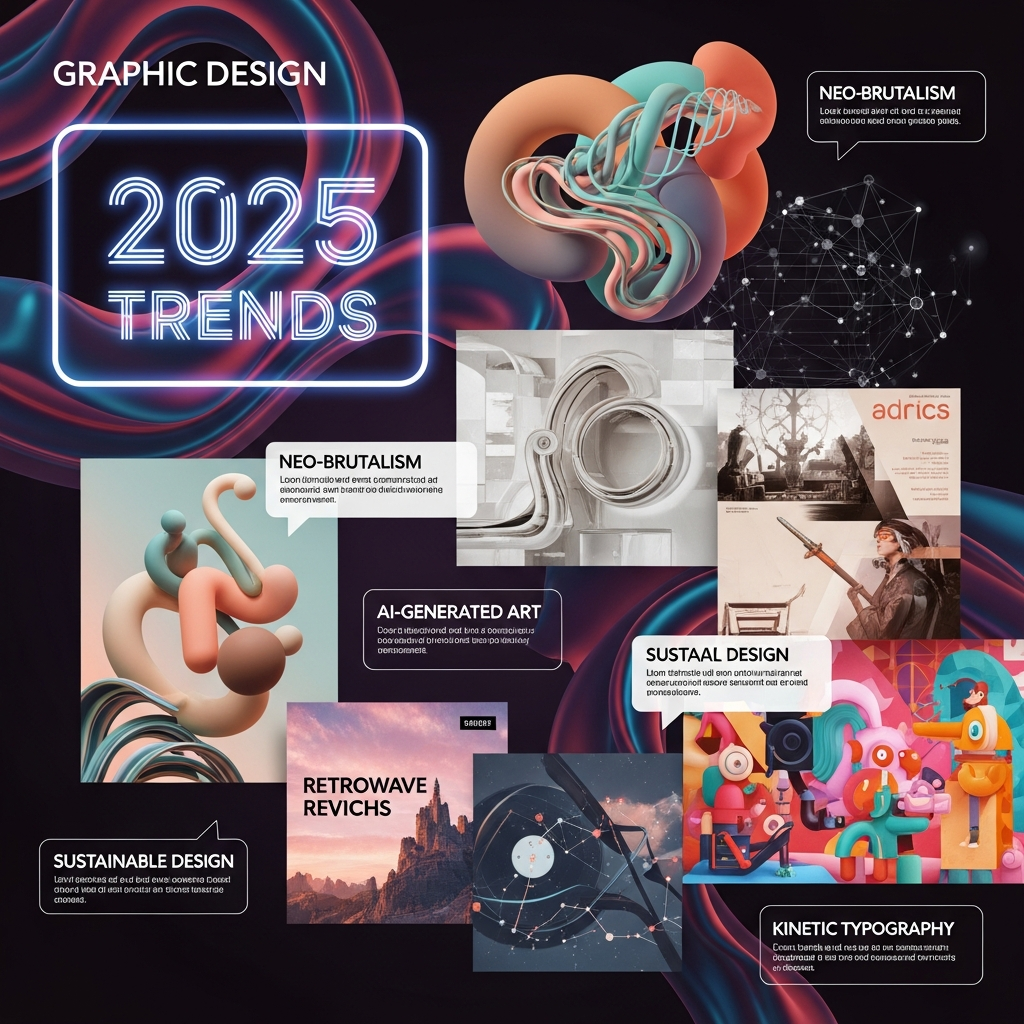
The landscape of visual communication is in constant motion, and understanding the core shifts is crucial for anyone creating or commissioning visual assets. What are the definitive Graphic Design Trends 2025 that will shape digital screens, print media, and brand identities? The coming year is characterized by a fascinating push and pull between two extremes: a yearning for authentic, tactile human imperfections and a seamless integration of hyper-modern, computationally-assisted creation. The most impactful Graphic Design Trends 2025 revolve around high-contrast visuals, a focus on digital-to-physical translations, and a deeper commitment to accessible design principles.

These are the primary Graphic Design Trends 2025 that will dominate the creative world:
- Minimalist Maximalism: A calculated, bold blend of simplicity and detailed embellishment.
- The Rise of the Handcrafted Digital: Embracing “chicken scratch” and structured scrapbooking aesthetics.
- Hyper-Textured and Grainy Finishes: Adding depth and a tactile feel to purely digital work.
- Advanced Computational Tools in Typography: Utilizing modern creative software to generate unique blur and distortion effects.
- Inclusive and Accessible Design First: A mandatory shift towards high-contrast, adaptable visuals.
—
The Calculated Balance: Minimalist Maximalism
One of the most compelling Graphic Design Trends 2025 is the emergence of what experts term “Minimalist Maximalism.” This style is not a contradiction; it is a carefully calibrated design philosophy that marries the clean lines and ample white space of traditional minimalism with the detailed, sensory overload of maximalism. It represents a mature evolution, where every element, even the extra ones, has a clear purpose. It is a refinement of visual noise, transforming chaos into a deliberate, structured richness.
For years, the design world favored stark, almost sterile minimalism, but this approach often left brands feeling cold or undifferentiated. In contrast, the Graphic Design Trends 2025 are pushing creators to inject personality back into simplicity. Think of a clean, sans-serif logotype placed against a single, vast background of intensely intricate, textured metallic grain or a simple layout featuring one dramatically hypercolor illustration. The minimalist framework acts as an anchor, preventing the maximalist elements from spiraling out of control. This blend demands exceptional restraint and an acute understanding of visual hierarchy, making it one of the most sophisticated Graphic Design Trends 2025.
The practical application of this trend can be seen in packaging and web interfaces. A brand might use a clean, gridded layout (the minimalist core) but fill the negative space with moving, subtle motion graphics or a repeating pattern of highly detailed, almost psychedelic imagery (the maximalist layer). This duality ensures immediate readability while providing a rewarding visual experience upon closer inspection. The success of Graphic Design Trends 2025 like this hinges on making a powerful statement without sacrificing clarity. This focus on high-impact simplicity solidifies Minimalist Maximalism as a key theme in Graphic Design Trends 2025.
The Charm of Imperfection: Handcrafted Digital and Structured Scrapbook
As digital tools become increasingly flawless, there is a natural human counter-movement seeking authenticity and warmth. This backlash against perfection is manifesting as a resurgence of “handcrafted” aesthetics, a crucial component of Graphic Design Trends 2025. This doesn’t mean a return to analog design, but rather a deliberate use of digital tools to simulate the irregular, textured, and slightly messy feel of human touch.
The ‘chicken scratch’ and ‘structured scrapbook’ movements are prime examples of this phenomenon among the Graphic Design Trends 2025. ‘Chicken scratch’ typography involves using fonts that resemble quick, handwritten notes or imperfect scribbles, immediately injecting a sense of urgency, informality, and personality into the message. It breaks down the corporate barrier and makes communication feel direct and personal. This trend contrasts sharply with the polished, corporate fonts that dominated the previous decade, highlighting the shift towards a more relatable visual language. The incorporation of this messy, personal touch is a standout feature of the emerging Graphic Design Trends 2025.
Similarly, the ‘structured scrapbook’ style digitizes the look of cut-and-paste elements, tape, torn paper, and layered ephemera. It uses a collage approach, but unlike truly chaotic maximalism, it often adheres to a loose, almost grid-like structure (hence the “structured” part). This creates a nostalgic, tangible feel that resonates deeply with audiences tired of hyper-slick, glossy visuals. Businesses are using this approach to humanize their brands, often layering illustrations, personal photography, and varied typography to tell a story that feels genuinely curated, not just rendered. Mastering the art of making something digital look authentically flawed is one of the most important skills for anyone engaging with Graphic Design Trends 2025.
The psychological draw here is profound: imperfection equals humanity. When consumers see a design that looks slightly off, slightly rough around the edges, they perceive it as more honest and trustworthy. This is especially true in a world where modern creative software can generate incredibly polished visuals instantaneously. Embracing these charming imperfections is what sets these specific Graphic Design Trends 2025 apart from the high-polish aesthetic of years past. The raw energy of the handcrafted look will define the feel of many major campaigns as they adopt the Graphic Design Trends 2025.
Depth and Feel: Hyper-Textured and Grainy Finishes
The digital screen is flat by nature, yet a significant theme in Graphic Design Trends 2025 is the relentless pursuit of perceived depth and texture. Designers are using digital effects to make images and typefaces feel physically tactile, as if one could reach out and feel the grit, the sheen, or the weave of the material. This shift is driven by a desire to create a richer, more immersive visual experience that engages the senses beyond just sight.
One popular approach within Graphic Design Trends 2025 is the intense use of textured grains. This involves layering subtle, high-resolution noise or film-grain effects over solid color fields, photographs, or illustrations. The grain breaks up the uniformity of the digital canvas, giving the impression that the work was printed on heavy, slightly imperfect paper stock. This adds an immediate sense of vintage quality and warmth, moving the visual away from the cold perfection of vector graphics. When applied to typography or large blocks of color, the grain introduces a sophisticated visual disturbance that is pleasing to the eye.
Another dimension of this trend is the use of metallics and reflective surfaces. Designers are cleverly manipulating gradients and highlights to simulate the look of chrome, brass, or anodized finishes. This effect adds a sense of luxury and futuristic flair, particularly when paired with the aforementioned minimalist maximalism. The interplay of light—how a metallic surface would reflect light in a physical space—is digitally rendered to add a sense of movement and dimensionality. This technique gives flat logos or icons a stunning 3D presence, making it a powerful element among the Graphic Design Trends 2025.
The combination of textured grains and subtle metallic effects creates a ‘retrofuturism’ vibe, which is quickly becoming a signature aesthetic of Graphic Design Trends 2025. This involves looking back at the optimism of 20th-century visions of the future (like 80s sci-fi or mid-century space-age design) and updating them with modern digital fidelity. The hyper-texture acts as a bridge, grounding the futuristic metallic elements in a warm, nostalgic reality. This meticulous attention to surface detail is a characteristic of the most successful Graphic Design Trends 2025.
The Reimagination of Type: Blur, Distortion, and Fluid Gradients
Typography has always been the backbone of visual communication, and the Graphic Design Trends 2025 are pushing the boundaries of what type can be. Gone are the days when fonts were merely legible; now, they are meant to be dynamic, expressive, and often the primary visual element of a design. Modern creative software allows designers to manipulate type with effects previously only possible in highly complex 3D environments, leading to stunning results that define the Graphic Design Trends 2025.
Blur and Distortion as Expressive Tools
The use of blur and distortion is one of the most exciting typographic features among the Graphic Design Trends 2025. Rather than using these effects to imply movement or error, designers are applying them in a calculated, artistic manner. A key word or headline might be intentionally blurred just enough to create an aura of mystery or a shimmering, watery effect, yet remain perfectly readable. Distortion effects, like stretching letters or creating wave-like ripples, introduce a surreal, almost glitchy aesthetic that mirrors the current digital zeitgeist. This approach treats type as a sculpted object, not just a readable string of characters. This focus on type as art is a cornerstone of the Graphic Design Trends 2025.
This trend is also intrinsically linked to the concept of seriousness with a playful twist. The sophisticated manipulation of type—turning a clean serif font into a fluid, distorted visual—demonstrates technical mastery while injecting a healthy dose of visual fun. This is a noticeable shift from the ultra-serious branding of the past decade. Brands adopting these Graphic Design Trends 2025 communicate that they are both technologically savvy and creatively fearless. The fluid nature of these text effects is a hallmark of the newest wave of Graphic Design Trends 2025.
The Revival of Gradients and Hypercolor
Along with distorted type, Gradients and Blends are making a major comeback in the Graphic Design Trends 2025, but with a significant evolution. The flat, simple gradients of the past have been replaced by vibrant, multi-layered color transitions known as hypercolor. These are less about a subtle fade and more about an explosion of light and shade, often using neon, almost synthetic color palettes. The gradients are used to define shape, suggest light source, and add profound depth to abstract shapes, icons, and backgrounds.
These hypercolor gradients are often paired with serif typography. The combination is a striking juxtaposition: the traditional, authoritative structure of a serif font set against a background of fluid, luminous, and often jarring color shifts. This fusion of old and new is highly effective in grabbing attention in a crowded digital space. It’s a complex, visually arresting approach that defines a core tenet of Graphic Design Trends 2025—the fusion of disparate visual languages. The bold application of color makes these specific Graphic Design Trends 2025 pop.
The Imperative of Inclusion: Accessible and Inclusive Design
Perhaps the most important development and non-negotiable requirement among the Graphic Design Trends 2025 is the formalization of accessible and inclusive design practices. This is no longer a niche concern or an optional ‘nice-to-have’; it is an essential foundation for all modern visual communication. Accessibility ensures that design works for everyone, regardless of their physical or cognitive abilities, while inclusivity ensures that diverse perspectives and experiences are represented.

For Graphic Design Trends 2025, this means a technical commitment to several key principles:
- High Contrast and Readability: Designs must prioritize legibility. This means strictly adhering to contrast ratios for text against backgrounds, ensuring that typefaces are clean, well-spaced, and scalable. The trend for bold typography and simple, yet high-contrast, text layouts directly supports this goal.
- Adaptable Layouts: Visuals must be designed to adapt seamlessly across a multitude of devices and screen readers. This focuses on creating flexible layouts and using appropriate tags for non-visual consumers of the content. This is a foundational element of responsible Graphic Design Trends 2025.
- Inclusive Imagery and Representation: Moving beyond tokenism, the visual world in Graphic Design Trends 2025 demands authentic representation. Imagery, illustration, and photography must reflect the true diversity of the global audience, avoiding stereotypes and generic, unrepresentative stock photos.
The movement towards accessible and inclusive Graphic Design Trends 2025 is also tied to the Return to Craft and the focus on human connection. By designing with a deeper empathy for the end-user, creators are required to slow down and consider the real-world impact of their choices. This philosophical shift elevates design from mere decoration to a responsible form of public communication. The commitment to ethical design is what truly defines the most important Graphic Design Trends 2025. This focus on the human factor within the Graphic Design Trends 2025 is a major area of growth.
The Influence of Advanced Creative Software on Visuals
We must acknowledge the profound impact of sophisticated, computationally-assisted design tools on the Graphic Design Trends 2025. While the initial novelty phase of these tools has passed, the year 2025 will see their mature integration, where they transition from being novel generators to becoming true “co-designers”. The design world is learning to leverage the speed and pattern-generating capabilities of these tools to achieve unprecedented levels of complexity and personalization.
For example, motion graphics and animation, which are central to the Graphic Design Trends 2025, are becoming hyper-realistic and impactful through computational assistance. Tasks that once took weeks—like complex physical simulations, hyper-detailed rendering of metallics and textures, or generating hundreds of visual variations—can now be executed in hours. This frees the human designer to focus entirely on the refinement, originality, and emotional storytelling of the work, rather than the mechanical execution. This shift in workflow is one of the most significant changes underpinning the visual aesthetic of Graphic Design Trends 2025.
The best work in Graphic Design Trends 2025 will be the one that finds the “sweet spot” between computational power and human ingenuity. Designers are using these tools to create initial concepts, generate vast libraries of patterns, or refine texturing, but the final, distinctive visual style is layered on by human expertise. This hybrid approach allows for the creation of truly unique and dynamic designs that are impossible to replicate manually, ensuring that the Graphic Design Trends 2025 are visually richer than ever before. This collaboration between human and machine is rapidly accelerating the development of Graphic Design Trends 2025.
The Physical-Digital Bridge: From Screen to Real Life
The final major theme among the Graphic Design Trends 2025 is the desire to bridge the gap between the purely digital screen and the tangible, physical world. After years of increasing digitalization, there is a clear demand for designs that celebrate the ‘return to physical experiences’. This affects everything from branding to merchandising and wayfinding.
This trend is partially fueled by the rise of Retro Modernism, which integrates classic design principles with contemporary rendering techniques. Designers are drawing inspiration from mid-century print, packaging, and industrial design, characterized by bold, simple shapes and clear visual communication. However, they are updating this aesthetic by using hypercolor gradients and advanced texturing, giving the retro elements a fresh, future-facing appearance. The adoption of this style is a significant aspect of Graphic Design Trends 2025.
Key visual elements reflecting this physical-digital bridge in Graphic Design Trends 2025 include:
- Geometric Shapes and Bold Outlines: A return to foundational shapes (circles, squares, triangles) used in bold, sometimes overlapping compositions. This simplicity makes the designs instantly transferable to physical media like merchandise, signage, or stickers, creating strong brand recognition that works off-screen.
- Pixellation and Low-Fidelity: In a counter-intuitive twist, designers are using ‘pixels’ and low-fidelity visuals. This harks back to early digital aesthetics, creating a sense of ‘digital nostalgia.’ When seen in physical print or on a high-definition screen, the intentional pixellation creates a deliberate, artistic contrast, mimicking the charm of early video games or primitive digital art. This deliberate low-res look is a striking feature of Graphic Design Trends 2025.
- Handcrafted Design Elements in Print: The use of handcrafted elements, previously discussed, translates perfectly to physical packaging. Think of wine labels with ‘chicken scratch’ type or product boxes with a ‘structured scrapbook’ collage that feels like it was put together by hand. This enhances the tactile experience and boosts the perceived value of the product. These specific Graphic Design Trends 2025 elevate the mundane.
In essence, the most successful Graphic Design Trends 2025 are those that maintain a consistent visual identity whether they are displayed on an animated website background or printed on a matte business card. This focus on seamless transition between digital and physical realms demonstrates a holistic approach to branding that will be paramount in 2025. The emphasis on physical touchpoints makes these Graphic Design Trends 2025 especially relevant for consumer goods.
—
Conclusion: The New Humanism in Visuals
The overall picture painted by the Graphic Design Trends 2025 is one of complexity, nuance, and a deeply felt desire for human connection. The future of visual design is not about choosing between technical perfection and human authenticity; it is about finding the profound synergy between them. The dominant styles, from Minimalist Maximalism to the Handcrafted Digital aesthetic, all strive to balance high-tech execution with high-touch emotion.
For creative professionals and brands looking to stay ahead, the key is selective adoption. Not every one of the Graphic Design Trends 2025 will suit every brand. The true innovation lies in understanding the core why—the audience’s desire for honesty, personality, and sensory depth—and applying the relevant visual techniques.
The shift towards accessible and inclusive practices is the ethical anchor of the Graphic Design Trends 2025, ensuring that this visual richness is available to everyone. By embracing both the precision of computational tools and the warm imperfections of the hand, the Graphic Design Trends 2025 promise a year of unprecedented visual excitement, depth, and human relevance. The continued development of these key Graphic Design Trends 2025 will shape the industry for years to come.
—
FAQ (Frequently Asked Questions)
What are the main Graphic Design Trends 2025 focusing on?
The main Graphic Design Trends 2025 are focusing on a calculated blend of opposing forces: simplicity versus complexity, and digital perfection versus human imperfection. Key trends include Minimalist Maximalism, which combines clean layouts with rich details; the Handcrafted Digital look, which uses deliberate imperfections like “chicken scratch” type; and a strong emphasis on Accessible and Inclusive Design with high-contrast visuals.
How can a brand naturally use the “Handcrafted Digital” look within the Graphic Design Trends 2025?
A brand can use the Handcrafted Digital style by incorporating elements like structured scrapbooking or textured grains into their assets. This involves digitally simulating the look of torn paper, hand-drawn annotations, or film grain over photographs and solid colors. This approach, part of the wider Graphic Design Trends 2025, makes the brand feel more authentic, human, and less corporate, fostering trust and emotional connection with the audience.
Why is accessibility a major element of Graphic Design Trends 2025?
Accessibility has become a non-negotiable standard within the Graphic Design Trends 2025 because it represents an ethical commitment to inclusive communication. It requires designers to prioritize high-contrast color choices, legible typography, and adaptable layouts to ensure that all individuals, including those with visual impairments, can easily consume and understand the content. This shift is integral to responsible and effective visual design in 2025.
Will minimalist design completely disappear in Graphic Design Trends 2025?
No, traditional minimalism is not disappearing, but it is evolving into Minimalist Maximalism, a key component of the Graphic Design Trends 2025. The core minimalist principles of clear structure and ample negative space remain, but designers are strategically introducing rich, maximalist elements—like detailed metallics, hypercolor gradients, or complex animations—into that clean framework. This creates a high-impact visual that retains clarity while offering significant personality and depth.