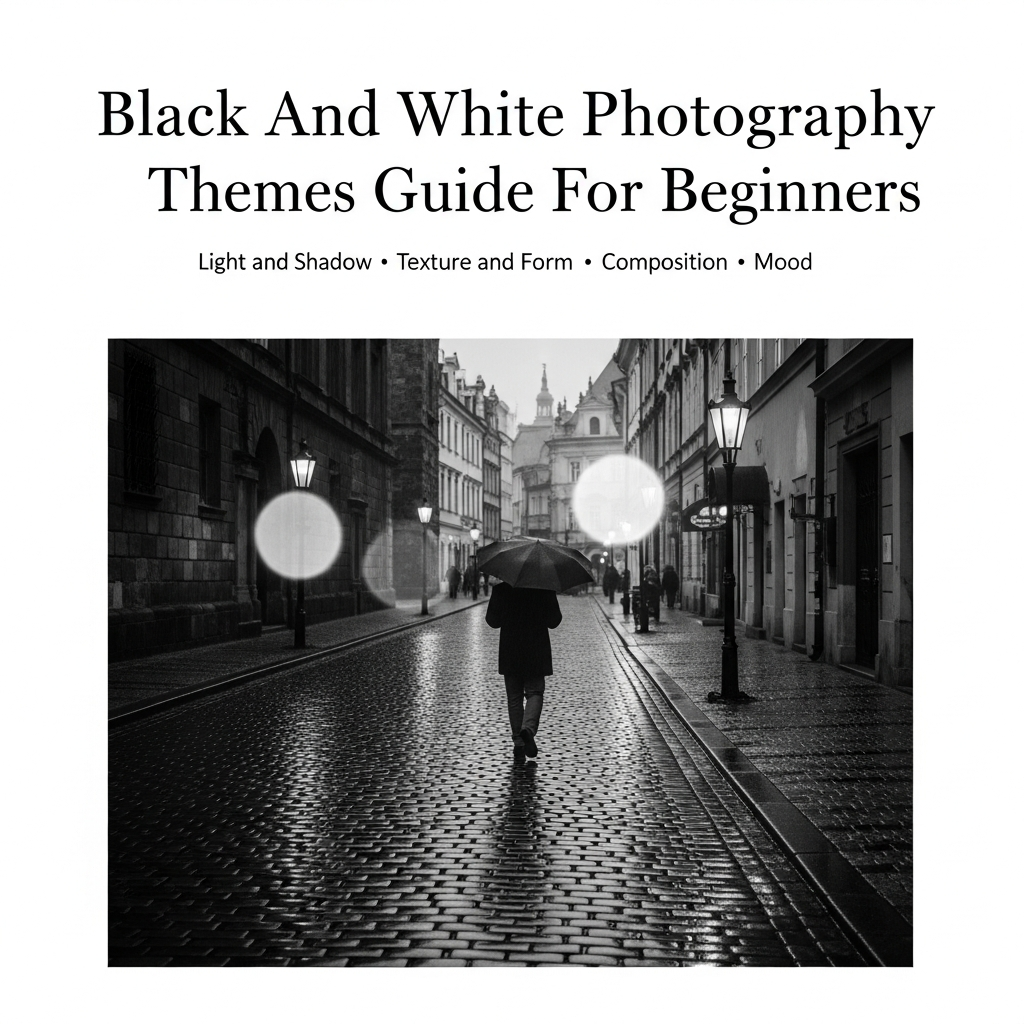
Black And White Photography Themes: The Ultimate Guide For Beginners
Black and white photography is far more than just a nostalgic throwback to the era of film. It is a sophisticated artistic choice that strips away the distraction of color to reveal the raw essence of a subject. For a beginner, mastering black and white photography themes is one of the most effective ways to sharpen your “photographic eye.” When you remove color, you are forced to rely on fundamental elements like light, shadow, texture, and composition.
In this comprehensive guide, we will explore the most impactful themes for monochrome enthusiasts, the technical settings you need to master, and the artistic principles that turn a simple grayscale image into a timeless masterpiece. Whether you are using a professional DSLR or a smartphone, this guide will provide you with the roadmap to excel in the world of monochrome.
Understanding the Essence of Black and White Photography
Before diving into specific themes, you must understand why black and white photography remains relevant in the digital age. In a world saturated with vibrant, high-definition colors, a monochrome image stands out because it simplifies the visual narrative.
The Power of Tonal Range
In monochrome photography, your “colors” are replaced by a spectrum of grays, ranging from absolute black to pure white. This is known as the tonal range. A successful black and white photo often features a wide tonal range, ensuring that there are deep shadows and bright highlights that create a sense of three-dimensionality.
Seeing in Shapes and Lines
Without color to differentiate objects, the human eye naturally looks for shapes, lines, and patterns. This is why architectural photography and minimalism work so well in black and white. You are essentially photographing the “skeleton” of the world.
The Role of Contrast and Lighting
Contrast is the soul of black and white imagery. High contrast—where the difference between light and dark is extreme—creates drama and tension. Low contrast—where the tones are mostly middle grays—creates a soft, ethereal, or melancholic mood. Understanding how light hits your subject is the first step toward becoming a master of this medium.
1. Street Photography: Capturing the Decisive Moment
Street photography is perhaps the most iconic theme within the monochrome world. Pioneers like Henri Cartier-Bresson utilized black and white to capture “The Decisive Moment.”
Why it Works in B&W
Color in a busy city street can be chaotic. Red cars, neon signs, and colorful clothing often distract from the human story. By converting these scenes to black and white, you focus the viewer’s attention on the emotions, gestures, and interactions of the people in the frame.
Tips for Beginners:
- Look for Silhouettes: Use strong backlighting to turn pedestrians into mysterious dark shapes against a bright pavement.
- Focus on Expressions: A wrinkled face or a fleeting smile often has more impact when the skin tones are rendered in grayscale.
- Use Leading Lines: Use crosswalks, railings, or the edges of buildings to guide the viewer’s eye toward your subject.
2. Architectural Minimalism: Lines and Geometry
Architecture is a playground for black and white photographers. Modern buildings, with their glass, steel, and concrete, provide a wealth of geometric patterns that are perfect for a minimalist theme.
The Beauty of Form
When you photograph a skyscraper in black and white, you aren’t just taking a picture of a building; you are capturing a series of intersecting lines and repeating patterns. The interplay of shadows on a curved wall can create an abstract piece of art that looks nothing like a physical structure.
How to Execute:
- Look Up: Perspective distortion can be your friend here. Pointing your camera straight up at a building can create dramatic converging lines.
- Symmetry vs. Asymmetry: Try to find perfect symmetry in a facade, or break the rules by placing a single window off-center to create visual tension.
- Texture of Materials: Contrast the smooth surface of glass with the rough texture of weathered brick or brushed aluminum.
3. Portraiture: Emotions and Character
If you want to capture the “soul” of a person, black and white is the way to go. Color portraits often focus on the beauty of the skin or the color of the eyes. Black and white portraits, however, focus on the character and story behind the face.
Emphasizing Texture
In monochrome portraiture, every wrinkle, freckle, and strand of hair becomes a vital part of the composition. It adds a level of grit and honesty that color often masks.
Techniques for Beginners:
- Focus on the Eyes: The eyes are the focal point of any portrait. Ensure they are sharp and have a “catchlight” (a small reflection of light) to make them look alive.
- Use Side Lighting: Lighting your subject from the side (Rembrandt lighting) creates deep shadows on one side of the face, adding depth and a sense of mystery.
- High-Key vs. Low-Key: A “high-key” portrait (mostly whites and light grays) feels airy and optimistic. A “low-key” portrait (mostly blacks and dark grays) feels moody and intense.
4. Landscape and Nature: Drama and Scale
Landscape photography in black and white is about capturing the grandeur and texture of the natural world. Ansel Adams, the father of modern landscape photography, proved that you don’t need the colors of a sunset to create a breathtaking image.
Visualizing the Landscape
When shooting landscapes, look for “texture” in the clouds, “rhythm” in the rolling hills, and “contrast” between a dark mountain and a snow-capped peak.
Essential Strategies:
- Use Filters: In the digital age, you can use “digital filters” in post-processing. A red filter, for example, will darken a blue sky, making white clouds pop with incredible drama.
- Long Exposure: Use a tripod and a slow shutter speed to blur moving water or clouds. In black and white, this creates a silky, ethereal texture that contrasts beautifully with solid rocks.
- Foreground Interest: Since you lack color to draw the eye, use a strong foreground element (like a textured rock or a fallen branch) to create a sense of scale.
5. Still Life and Macro: The Beauty in Details
Still life photography allows you to have total control over your environment. This is an excellent theme for beginners to practice lighting and composition without the pressure of a moving subject.
Finding Art in the Ordinary
A simple bowl of fruit, a stack of old books, or a single flower can become a masterpiece when stripped of color. Macro photography (extreme close-ups) takes this a step further by revealing textures that are invisible to the naked eye.
Tips for Success:
- Play with Light: Use a single lamp or a window to experiment with how light falls across an object. Watch how the shadows change as you move the light source.
- Focus on Textures: The veins of a leaf, the weave of a fabric, or the rust on a metal bolt all become fascinating subjects in monochrome.
- Compositional Balance: Use the “Rule of Thirds” or “Golden Ratio” to place your objects in a way that feels balanced and intentional.
6. Abstract Themes: Shapes and Shadows
Abstract photography is about moving away from the “literal” and toward the “conceptual.” Black and white is the perfect medium for abstraction because it already moves one step away from reality.
Creating Mystery
An abstract photo might be a close-up of a shadow on a sidewalk, the reflection of a building in a puddle, or the patterns of light filtering through a venetian blind. The goal is to make the viewer ask, “What am I looking at?” before they realize the subject.
How to Approach Abstraction:
- Isolate Elements: Use a zoom lens to crop into a small part of a larger scene.
- Look for Patterns: Repeating shapes, like the steps of an escalator or the petals of a flower, create a rhythmic visual experience.
- Experiment with Motion Blur: Intentionally moving your camera during a long exposure can create streaks of light and dark that look like a charcoal drawing.
7. Urban Decay and Industrial Themes
There is a unique beauty in things that are broken, weathered, or abandoned. This theme, often called “Urban Exploration” (Urbex), is perfectly suited for black and white.
The Grit Factor
The rust on an old train, the peeling paint of an abandoned house, and the cracked glass of a factory window all provide incredible textures. In black and white, these elements feel more dramatic and poignant, evoking a sense of history and the passage of time.
Key Considerations:
- Safety First: Always ensure you have permission to enter abandoned locations and prioritize your personal safety.
- Wide and Tight: Take wide shots to show the desolation of the space, but also take “tight” shots of small details like a rusted hinge or a dusty chair.
- Mood Lighting: Overcast days are often better for this theme, as the soft, diffused light brings out the subtle details in the shadows.
Technical Guide: Setting Up Your Camera for B&W
While you can always convert a color photo to black and white in post-processing, your approach during the shoot matters significantly.
1. Shoot in RAW Format
This is the most important technical tip. A RAW file contains all the data captured by your sensor. If you shoot in JPEG (Monochrome mode), the camera throws away the color data. By shooting in RAW, you keep the color information, which gives you much more flexibility when you adjust the tonal balance later in software like Lightroom or Photoshop.
2. Use the “Monochrome” Picture Style (as a Preview)
Most modern cameras allow you to set your “Picture Style” to Monochrome. If you are shooting in RAW, your camera will show you a black and white preview on the LCD screen, but it will still save the full color RAW file. This helps you “see” in black and white while you are shooting.
3. Keep ISO as Low as Possible
In color photography, “noise” (digital grain) is usually seen as a negative. In black and white, grain can actually add a film-like, artistic quality. However, it is better to have a clean image and add “artistic grain” later in post-processing rather than having “digital noise” from a high ISO setting that ruins your detail.
4. Pay Attention to the Histogram
In monochrome, you want to avoid “clipping” your whites (making them pure white with no detail) or “crushing” your blacks (making them pure black with no detail), unless that is a specific artistic choice. Check your histogram to ensure you have a healthy distribution of tones.
Post-Processing: Bringing Your Vision to Life
The magic of black and white photography often happens in the “digital darkroom.” Converting an image to grayscale is just the beginning.
The Black and White Mixer
In software like Adobe Lightroom, the B&W Mixer is your most powerful tool. It allows you to adjust the luminance of specific colors. For example, if you want to make a blue sky darker, you simply slide the “Blue” slider to the left. This mimics the effect of using physical glass filters on a film camera.
Contrast, Highlights, and Shadows
- Increase Contrast: To make the image “pop.”
- Adjust Clarity: Increasing clarity adds “mid-tone contrast,” which makes textures (like stone or skin) look much more defined.
- Dodge and Burn: This is a classic darkroom technique. “Dodging” means lightening specific areas, while “burning” means darkening them. Use this to lead the viewer’s eye to your subject.
Expert Tips for Mastering Black and White Themes
- Study the Masters: Look at the work of Fan Ho, Daido Moriyama, and Sebastiao Salgado. Analyze how they use light and shadow to tell a story.
- Look for “Luminance Contrast”: Since you don’t have color contrast (like red against green), you must look for luminance contrast (light against dark). A white bird against a dark forest is a perfect B&W subject.
- Don’t Use B&W to Save a Bad Photo: Many beginners try to convert a blurry or poorly composed photo to black and white hoping it will look “artistic.” It won’t. A bad photo is a bad photo, regardless of the color.
- Practice in Mid-Day Sun: While color photographers hate the “harsh” mid-day sun, black and white photographers love it! The harsh shadows and bright highlights create the high contrast needed for dramatic monochrome shots.
Conclusion: Your Journey into Monochrome
Mastering black and white photography themes is a journey of simplification. It is about stripping away the superficial layers of the world to find the underlying structure, emotion, and drama. As a beginner, do not be afraid to experiment. Try different themes, play with harsh lighting, and push your post-processing boundaries.
By focusing on shapes, textures, and the interplay of light and shadow, you will not only become a better black and white photographer but a better photographer overall. The world looks different in monochrome—it’s time you started seeing it that way.
Frequently Asked Questions (FAQ)
1. Is black and white photography harder than color?
It isn’t necessarily harder, but it requires a different way of thinking. You have to train your brain to ignore color and focus on light, shadow, and composition.
2. Can I do black and white photography with my smartphone?
Absolutely! Most smartphones have excellent “Noir” or “Monochrome” filters. For better results, use a third-party app that allows you to shoot in RAW format.
3. Why do some black and white photos look “flat”?
A “flat” photo usually lacks contrast. It consists mostly of middle grays without any true blacks or true whites. Adjusting the contrast or the whites/blacks sliders in post-processing can fix this.
4. What is the best lens for black and white photography?
There is no single “best” lens, but prime lenses (like a 35mm or 50mm) are popular because they are sharp and usually have wider apertures, allowing for beautiful “bokeh” (background blur) which looks great in monochrome.
5. Should I always shoot in color and convert later?
Yes, if you are shooting digitally. Shooting in RAW (color) gives you the most control over the final look of your black and white image during the editing process.