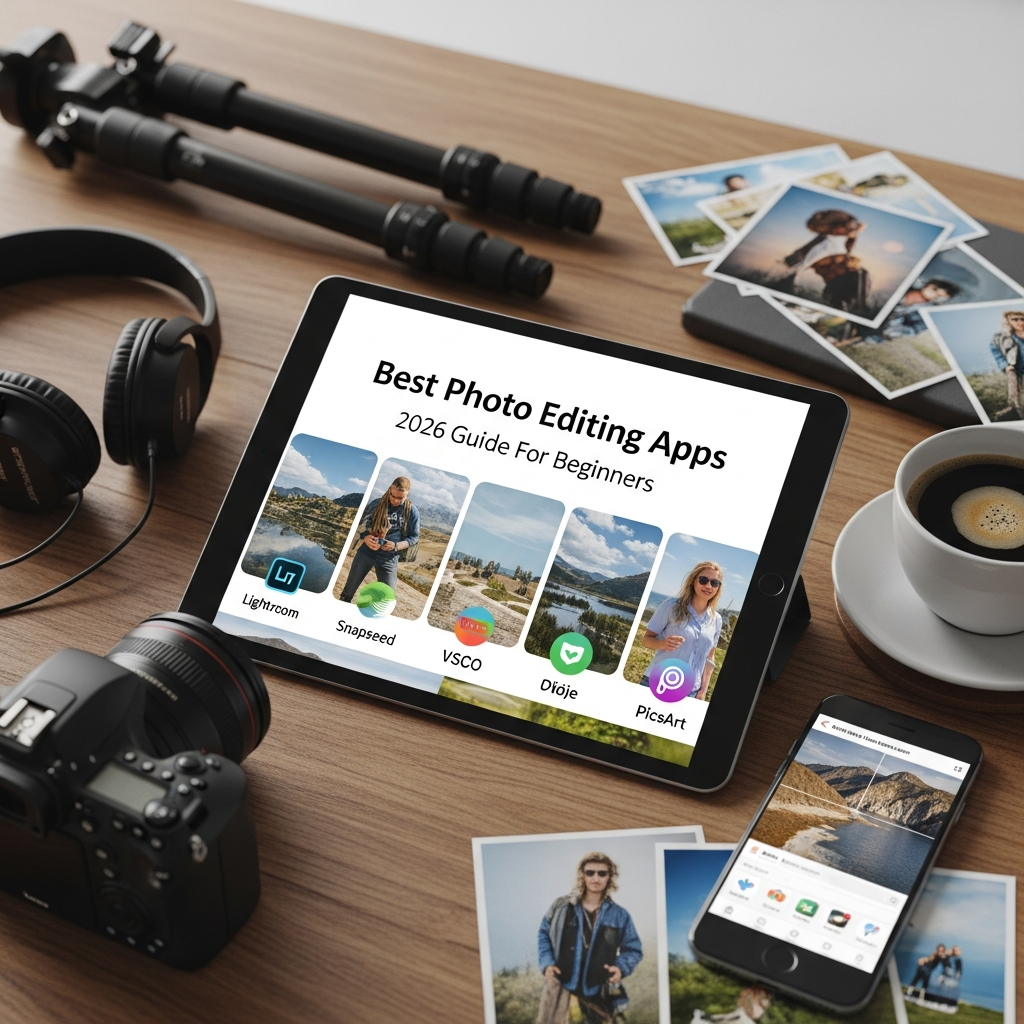
Best Photo Editing Apps 2026: The Ultimate Beginner’s Guide to Professional Results
The landscape of digital photography has undergone a seismic shift as we navigate through 2026. Gone are the days when high-end photo manipulation was reserved for those with expensive desktop setups and years of technical training. Today, the power to create breathtaking visual art resides right in your pocket.
Whether you are an aspiring influencer, a small business owner, or someone who simply wants to preserve memories in the best possible light, choosing the right tool is paramount. This guide will walk you through the best photo editing apps 2026 has to offer, specifically tailored for beginners who demand professional-grade results without the steep learning curve.
The Evolution of Mobile Photo Editing in 2026
In 2026, the primary driver of innovation in the creative industry is Artificial Intelligence (AI). We have moved beyond simple filters. Modern mobile photo editing now utilizes neural engines to understand the context of an image.
The current generation of apps can distinguish between a sunset and a sunrise, identify specific skin textures to preserve natural beauty, and even reconstruct missing parts of a landscape using generative fill. For you as a beginner, this means that the “technical” barrier has vanished, replaced by intuitive interfaces that prioritize your creative vision over manual slider adjustments.
Why You Need a Dedicated Photo Editing App
You might wonder why the native editor on your smartphone isn’t enough. While built-in tools are improving, dedicated apps offer several distinct advantages:
- Non-Destructive Editing: Professional apps allow you to make changes without overwriting the original file, ensuring you never lose your source data.
- RAW Editing Support: To get the most out of your camera, you need to edit RAW files, which contain more data than standard JPEGs.
- AI Image Enhancer Tools: These tools can upscale low-resolution photos and remove noise with surgical precision.
- Batch Processing: Save time by applying the same aesthetic to dozens of photos simultaneously.
Top 10 Best Photo Editing Apps in 2026 for Beginners
Selecting the right software can be overwhelming. To simplify your journey, we have curated and tested the most effective apps available this year.
1. Adobe Lightroom Mobile: The Industry Gold Standard
Adobe Lightroom remains the titan of the industry. In 2026, its mobile version is nearly indistinguishable from its desktop counterpart.
- Best For: Beginners who want to grow into professional photography.
- Key Features: Advanced RAW editing, cloud synchronization, and “Adaptive Presets” that use AI to detect subjects and skies automatically.
- Why You’ll Love It: The “Discover” tab allows you to see exactly how pros edit their shots, providing a step-by-step blueprint for your own work.
2. Canva: The All-in-One Creative Suite
While known for graphic design, Canva’s photo editing capabilities in 2026 are world-class for social media creators.
- Best For: Small business owners and social media enthusiasts.
- Key Features: One-click background removal, Magic Edit (generative AI), and an extensive library of templates.
- Why You’ll Love It: It bridges the gap between a simple photo and a finished marketing asset.
3. Snapseed: The Best Free Powerhouse
Developed by Google, Snapseed continues to be the best completely free app without annoying ads or subscriptions.
- Best For: Users on a budget who want high-end control.
- Key Features: “Control Points” for selective editing and the “Expand” tool which uses AI to grow the edges of your photo.
- Why You’ll Love It: The interface is gesture-based, making it incredibly tactile and easy to learn.
4. Luminar Neo Mobile: The AI Specialist
Skylum’s Luminar Neo has brought its famous “one-click” AI magic to mobile platforms.
- Best For: Beginners who want instant, dramatic improvements.
- Key Features: Sky AI (replaces dull skies), Relight AI (adjusts lighting in 3D space), and GenErase.
- Why You’ll Love It: It handles the complex math of lighting and perspective for you.
5. VSCO: For the Aesthetic Enthusiast
VSCO remains the leader for those who love the look of classic film photography.
- Best For: Creating a consistent, “filmic” look for Instagram.
- Key Features: High-quality film emulations and a curated community of creators.
- Why You’ll Love It: Its social media filters are sophisticated, avoiding the “over-edited” look of cheaper apps.
6. Picsart: The Creative Playground
Picsart is the go-to for photo manipulation and digital art.
- Best For: Gen-Z creators and digital artists.
- Key Features: Sticker maker, AI image generator, and layer-based editing.
- Why You’ll Love It: It feels more like a creative studio than a traditional darkroom.
7. Fotor: The Quick Fix Expert
Fotor excels at taking a “meh” photo and making it “wow” in seconds using its AI image enhancer.
- Best For: Quick touch-ups and portrait retouching.
- Key Features: One-tap enhance, AI skin retouch, and collage maker.
- Why You’ll Love It: It is incredibly straightforward and doesn’t require any prior knowledge of photography terms.
8. Darkroom: The Seamless iOS Experience
If you are an iPhone or iPad user, Darkroom offers the most integrated experience.
- Best For: Apple ecosystem users.
- Key Features: Deep integration with iCloud Photos and video editing capabilities.
- Why You’ll Love It: It doesn’t require you to import photos; it simply opens your existing library.
9. Pixlr: The Browser-Based Hybrid
Pixlr is perfect for those who switch between mobile and laptop frequently.
- Best For: Users who need flexibility across devices.
- Key Features: AI-powered cutout tools and a variety of decorative overlays.
- Why You’ll Love It: It offers a “Photoshop-lite” experience that is much easier to navigate.
10. Afterlight: The Texture King
Afterlight focuses on the “finishing touches”—textures, light leaks, and frames.
- Best For: Adding personality and grit to clean digital photos.
- Key Features: Real film textures and 130+ unique filters.
- Why You’ll Love It: The frames and borders are the most stylish in the category.
Essential Photo Editing Terms Beginners Must Know
Before you dive into the apps, you must understand the language of editing. Mastering these five terms will immediately improve your output.
- Exposure: This controls the overall brightness of your image. If your photo is too dark (underexposed) or too bright (overexposed), this is the first slider you should touch.
- Contrast: The difference between the darkest and lightest parts of a photo. Increasing contrast makes an image “pop,” while decreasing it creates a flat, moody look.
- Saturation vs. Vibrance: Saturation intensifies all colors equally. Vibrance is smarter; it intensifies the muted colors while leaving skin tones alone to prevent them from looking orange.
- Highlights and Shadows: Highlights control the brightest spots (like clouds), while Shadows control the dark areas. Use these to recover detail that seems lost.
- White Balance: This adjusts the “temperature” of your photo. If your indoor photo looks too yellow, you can use this to make it look natural.
Step-by-Step Guide: How to Edit Your First Photo Like a Pro
Follow this universal workflow, which applies to almost any of the best photo editing apps 2026 mentioned above.
Step 1: Clean Up the Composition
Start by using the Crop and Rotate tool. Follow the “Rule of Thirds”—place your subject on the intersecting lines of the grid. Ensure your horizon line is perfectly straight.
Step 2: Fix the Lighting (The Global Adjustments)
Adjust the Exposure first. Then, move to Highlights and Shadows. A common pro tip is to bring the highlights down (to see detail in the sky) and the shadows up (to see detail in the dark areas).
Step 3: Color Correction
Adjust the White Balance until the whites in your photo actually look white. Once the temperature is correct, add a touch of Vibrance to make the colors feel alive without looking fake.
Step 4: Utilize AI Enhancements
In 2026, most apps have an “Auto” or “AI Enhance” button. Use it! But don’t let it be the final word. Use it as a starting point, then tweak the results to match your personal style.
Step 5: Detail and Texture
Apply a small amount of Sharpening to make the edges crisp. If the photo was taken in low light, use the Noise Reduction tool to smooth out the graininess.
Step 6: Final Export
When saving your work, always choose the highest quality setting. If you plan to print the photo, ensure you are exporting in a format like PNG or high-quality JPEG.
2026 Trends: What’s Next for Mobile Photography?
As you master these apps, keep an eye on these emerging trends that are defining 2026:
- Generative Fill: The ability to add objects to a scene simply by typing a prompt.
- Depth-Aware Editing: Apps can now recognize the distance of objects, allowing you to add fog or light rays behind a subject but in front of the background.
- Voice-Command Editing: “Hey App, make this sunset more dramatic” is becoming a reality in high-end mobile suites.
- AR Integration: Previewing how a photo would look as a framed physical print on your wall before you even hit “save.”
Expert Tips for Beginner Photographers
To truly excel, remember that the app is only as good as the user.
- Don’t Over-Edit: The most common beginner mistake is pushing sliders to 100%. Subtlety is the hallmark of a professional.
- Edit with “Fresh Eyes”: After editing a photo, put your phone down for 10 minutes. When you come back, you’ll often realize you went too far with the saturation or contrast.
- Study the Light: No app can fully save a photo taken in terrible lighting. Try to shoot during the “Golden Hour” (shortly after sunrise or before sunset).
- Consistency is Key: If you are building a brand, try to use the same two or three presets for all your photos to create a cohesive visual identity.
Conclusion
The best photo editing apps 2026 have made it possible for anyone to produce gallery-quality images. From the comprehensive power of Adobe Lightroom to the AI-driven simplicity of Luminar Neo, there is a tool for every style and skill level.
As a beginner, your goal should not be to learn every single feature at once. Instead, pick one app that resonates with you, master the basic terminology, and focus on telling a story through your visuals. Photography is an art form, and these apps are simply the brushes you use to paint your masterpiece.
Frequently Asked Questions (FAQ)
1. What is the easiest photo editing app for a complete beginner?
Fotor and Canva are generally considered the easiest due to their “one-tap” AI features and intuitive drag-and-drop interfaces.
2. Are free photo editing apps as good as paid ones in 2026?
Apps like Snapseed offer professional tools for free. However, paid apps like Lightroom or Luminar Neo provide advanced AI features and cloud storage that free versions usually lack.
3. Can I edit RAW photos on my smartphone?
Yes, most modern smartphones and apps like Lightroom, Snapseed, and Darkroom fully support RAW editing, allowing for much greater control over highlights and shadows.
4. Does AI photo editing make manual skills obsolete?
Not at all. While AI handles the “heavy lifting,” your creative vision—deciding the mood, composition, and story—remains the most important part of the process.
5. How do I remove a person from the background of my photo?
In 2026, most top-tier apps include a “Generative Erase” or “Magic Eraser” tool. Simply paint over the person you want to remove, and the AI will fill in the background seamlessly.