Graphic Design Trends 2026: The Ultimate Guide for Beginners
The world of visual communication is moving at an unprecedented pace. As we approach 2026, the landscape of graphic design is no longer just about “making things look pretty.” It has evolved into a complex intersection of artificial intelligence, emotional storytelling, and environmental consciousness. If you are a beginner looking to break into this industry, understanding these shifts is not just beneficial—it is essential for your survival and growth.
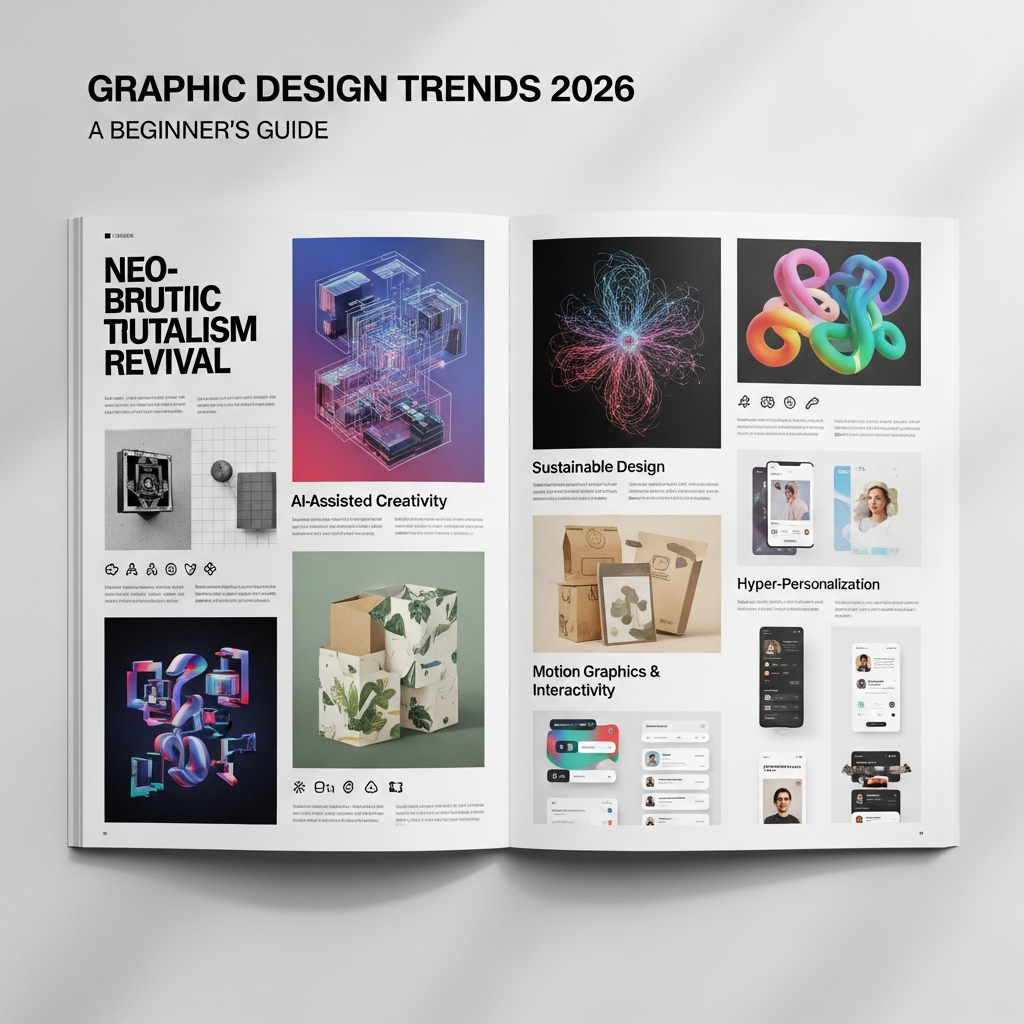
In this comprehensive guide, we will explore the Graphic Design Trends 2026 that are set to redefine how brands interact with their audiences. Whether you are a student, a freelance enthusiast, or a business owner, this roadmap will provide you with the insights needed to stay ahead of the curve.
The Evolution of Visual Communication: What Changes in 2026?
Before diving into specific aesthetics, you must understand the “why” behind the trends. By 2026, the digital and physical worlds will have blurred even further. We are moving away from static, flat designs toward dynamic, immersive experiences. The primary driver of this change is the maturation of technology and a global shift toward ethical consumption.
Design in 2026 is characterized by human-centricity. After years of hyper-digital perfection, there is a growing craving for “imperfection” and “soul” in design. You will notice that while tools become more automated, the value of a unique, human perspective becomes the most expensive commodity in the market.
1. AI-Augmented Creativity: From Tool to Co-Pilot
By 2026, the debate about whether AI will replace designers will have settled. The answer is a definitive “No,” but with a catch: Designers who use AI will replace those who do not. Generative AI is no longer a novelty; it is a fundamental part of the creative workflow.
The Rise of Prompt Engineering in Design
As a beginner, you must learn to “speak” to your tools. Prompt engineering is becoming a core skill. Instead of spending hours on basic photo manipulation, you will use AI to generate base assets, allowing you to focus on creative direction and strategic thinking.
- Asset Generation: Creating complex textures and backgrounds in seconds.
- Iterative Prototyping: Testing dozens of layout variations instantly.
- Personalization at Scale: Creating unique visual assets for thousands of individual users.
Ethical Design and AI Transparency
With great power comes great responsibility. A significant trend in 2026 is AI transparency. Brands will begin to value “Human-Made” certifications. As a designer, knowing how to balance AI efficiency with ethical sourcing of data and imagery will be a key differentiator for your professional reputation.
2. Sustainable Aesthetics and Eco-Branding
Sustainability is no longer a “nice-to-have” feature; it is a core design principle. In 2026, sustainable design goes beyond using the color green or leaf icons. It involves “Eco-Branding,” which focuses on reducing the environmental footprint of digital and physical assets.
Low-Carbon Web Design
Did you know that heavy graphics and complex code contribute to carbon emissions? Beginners in 2026 are adopting low-impact design techniques. This includes using optimized SVG graphics, limited color palettes to reduce screen energy consumption (especially on OLED screens), and efficient typography.
The “Earth-First” Color Palette
Expect to see a shift toward natural pigments and “undyed” aesthetics. The 2026 color forecast emphasizes:
- Terracotta and Clay: Grounding, warm neutrals.
- Deep Forest Greens: Connecting users to nature.
- Oceanic Blues: Promoting calm and clarity.
3. 3D Immersion and Spatial Design
With the rise of Augmented Reality (AR) and Virtual Reality (VR) hardware becoming mainstream, 3D design has moved from the fringes to the center of graphic design. In 2026, 2D design often feels “flat” and “dated” to younger audiences.
Hyper-Realistic Textures
Modern design software now allows beginners to create hyper-realistic 3D elements that users feel like they can touch. Glassmorphism, claymorphism, and iridescent textures are evolving into more sophisticated forms where lighting and physics play a crucial role.
Designing for the Metaverse and Spatial UI
You are no longer designing for a rectangular screen. Spatial design requires you to think about how a logo or an interface exists in a 3D space. This involves understanding depth, occlusion, and user movement. For a beginner, learning tools like Spline or Blender is now as important as learning Photoshop.
4. Kinetic Typography: Moving Beyond Static Text
In 2026, text is alive. Kinetic typography—or moving text—is the standard for social media, web headers, and digital billboards. Static fonts are being replaced by Variable Fonts that react to user behavior, sound, or scrolling speed.
The “Liquid Type” Movement
Typography in 2026 often takes on organic, fluid shapes. Letters stretch, melt, and morph. This trend breaks the traditional rules of legibility in favor of expressive communication. It is about capturing a “vibe” or an emotion rather than just delivering a message.
- Interactive Fonts: Letters that change weight as you hover your mouse.
- 3D Lettering: Typography that functions as a physical object in a digital space.
- Nostalgic Serifs: A return to elegant, high-contrast serifs but with a modern, digital twist.
5. Neo-Nostalgia and the Y3K Aesthetic
While the past few years were dominated by 90s and Y2K (Year 2000) nostalgia, 2026 is looking toward the Y3K aesthetic. This is a futuristic, “cyber-optimistic” style that imagines a high-tech future integrated with nature.
Retro-Futurism 2.0
This trend combines retro layouts (think 70s Swiss design) with futuristic elements like neon gradients, holographic overlays, and metallic finishes. It creates a sense of “familiar future”—something that feels safe yet excitingly new.
The Return of Grunge and Raw Textures
As a rebellion against the “too-perfect” AI art, digital grunge is making a comeback. This includes:
- Film Grain and Noise: Adding “soul” to digital images.
- Hand-Drawn Elements: Doodles and sketches layered over professional photography.
- Glitch Art: Embracing the beauty of digital errors.
6. Data Visualization as Art
In an age of information overload, the ability to make data beautiful is a superpower. In 2026, data visualization is moving away from boring bar charts and into the realm of abstract art. Brands are using their data to create generative patterns that serve as brand identity elements.
For beginners, this means learning how to translate complex statistics into visual stories. It is about finding the “human element” within the numbers and presenting it in a way that is both informative and aesthetically pleasing.
A Beginner’s Step-by-Step Guide to Mastering 2026 Trends
Staying relevant in 2026 requires a proactive approach. You cannot simply wait for trends to happen; you must experiment with them. Here is a step-by-step plan to help you navigate this new era.
Step 1: Master the Fundamentals (The “Timeless” Skills)
Before you chase trends, ensure your foundation is rock solid. Trends change, but the principles of design do not. Focus on:
- Color Theory: Understanding how colors affect human psychology.
- Grid Systems: The backbone of layout and organization.
- Hierarchy: Guiding the viewer’s eye to the most important information.
Step 2: Build an AI-Enhanced Workflow
Do not fear AI; embrace it. Start by incorporating AI tools into your daily practice. Use Midjourney or DALL-E 3 for mood boarding. Use Adobe Firefly for rapid image editing. The goal is to spend less time on “busy work” and more time on creative strategy.
Step 3: Diversify Your Toolset
In 2026, being a “Photoshop-only” designer is a limitation. To be competitive, you should explore:
- Figma: For UI/UX and collaborative design.
- Spline: For easy-to-use 3D web design.
- After Effects: For mastering motion graphics and kinetic type.
Step 4: Develop a “Niche” with a Human Touch
As AI becomes more prevalent, your unique personal style becomes your greatest asset. Whether it is your ability to draw by hand, your eye for photography, or your knack for storytelling, double down on what makes you “human.” Brands in 2026 will pay a premium for authenticity.
Expert Tips for Staying Ahead in the Design Industry
To truly excel as a professional in 2026, you must adopt the mindset of a lifelong learner. Here are some “pro-tips” from industry veterans:
- Curate Your Inspiration: Don’t just look at Pinterest. Look at architecture, fashion, nature, and classic film. Diverse inputs lead to unique outputs.
- Focus on Accessibility: Design for everyone. Inclusive design is a major trend in 2026. Ensure your color contrasts are readable and your layouts are navigable for people with disabilities.
- Learn Basic Coding: You don’t need to be a developer, but understanding HTML/CSS or Javascript will help you communicate better with tech teams and understand the limitations of digital design.
- Network with Purpose: The design community is moving toward smaller, “niche” enclaves. Join Discord servers, attend local meetups, and build genuine relationships.
Frequently Asked Questions (FAQ)
Will Graphic Design be a good career in 2026?
Yes, absolutely. However, the role is shifting from “execution” to “curation and strategy.” Designers who can think critically and solve business problems using visual tools will be in higher demand than ever.
What software should a beginner learn first in 2026?
Start with Figma for its versatility in UI/UX and layout, followed by Adobe Creative Cloud (Photoshop/Illustrator) for asset creation. Additionally, learning a 3D tool like Spline is highly recommended for 2026 trends.
How do I keep my designs from looking like “AI Art”?
The key is intentionality. Use AI to generate components, but use your own artistic judgment to compose, color-grade, and add unique “human” touches like hand-drawn textures or custom typography.
Is minimalism still popular in 2026?
Minimalism has evolved into “Warm Minimalism.” It is no longer about cold, empty spaces but about functional simplicity combined with soft textures, organic shapes, and a human touch.
Conclusion: Embracing the Future of Design
The Graphic Design Trends 2026 represent a fascinating era where technology and humanity finally find a balance. As a beginner, the key to success is not just mastering a specific software, but developing the adaptability to learn new ones while keeping your creative spark alive.
Remember, trends are just tools. Your ultimate goal as a designer is to communicate a message and evoke an emotion. Use these 2026 trends as a guide, but always let your unique perspective lead the way. The future of design is in your hands—make it meaningful, make it sustainable, and above all, make it yours.