Best Mirrorless Cameras 2025: The Ultimate Comprehensive Guide for Beginners
The landscape of digital photography has undergone a massive transformation. As we navigate through 2025, the era of the DSLR has firmly given way to the mirrorless revolution. For a beginner, entering this world can be both exhilarating and overwhelming. With manufacturers like Sony, Canon, Nikon, and Fujifilm releasing sophisticated technology at a rapid pace, how do you choose the right tool to start your creative journey?
This guide is designed to demystify the technical jargon and provide you with a clear, authoritative roadmap to selecting the best mirrorless cameras 2025. Whether you aim to capture stunning landscapes, start a YouTube channel, or document family milestones, finding a camera that balances ease of use with professional-grade features is essential.
What is a Mirrorless Camera and Why Should Beginners Care?
Before diving into specific models, it is crucial to understand what makes a mirrorless camera “mirrorless.” In traditional DSLR (Digital Single-Lens Reflex) cameras, a mechanical mirror reflects light into an optical viewfinder. When you take a photo, the mirror flips up to let light hit the sensor.
Mirrorless cameras eliminate this mechanical mirror. Light passes through the lens directly onto the digital sensor, which then previews the image on an Electronic Viewfinder (EVF) or the rear LCD screen. For you as a beginner, this offers several distinct advantages:
- What You See Is What You Get (WYSIWYG): The EVF shows you exactly how your exposure and colors will look before you press the shutter.
- Portability: Without a bulky mirror box, these cameras are significantly smaller and lighter, making them ideal for travel.
- Advanced Autofocus: Modern mirrorless systems use Artificial Intelligence to track eyes, animals, and vehicles with uncanny precision.
- Silent Shooting: The absence of a moving mirror allows for completely silent operation, perfect for candid photography or quiet events.
Key Features to Consider When Buying Your First Mirrorless Camera
When searching for the best mirrorless cameras 2025 for beginners, you must look beyond the megapixel count. Here are the core specifications that will impact your shooting experience:
1. Sensor Size: APS-C vs. Full-Frame
The sensor is the “heart” of the camera. Most beginners will choose between two types:
- APS-C (Crop Sensor): Smaller, more affordable, and allows for smaller lenses. This is the sweet spot for most beginners.
- Full-Frame: Larger sensors that perform better in low light and provide a shallower depth of field (blurry backgrounds). They are more expensive and heavier.
2. In-Body Image Stabilization (IBIS)
IBIS is a mechanism that moves the sensor to compensate for shaky hands. In 2025, this feature has become more common in entry-level models. It is a lifesaver for capturing sharp photos in low light or recording smooth video without a tripod.
3. Autofocus Capabilities
Look for cameras featuring Phase Detection Autofocus (PDAF) and AI-driven subject tracking. As a beginner, having a camera that automatically finds and locks onto a human eye allows you to focus on composition rather than fighting with technical settings.
4. Video Specifications
If you plan to create content for social media, ensure the camera supports at least 4K resolution. Look for features like a “flip-out” screen (vari-angle) and a microphone input to enhance your production value.
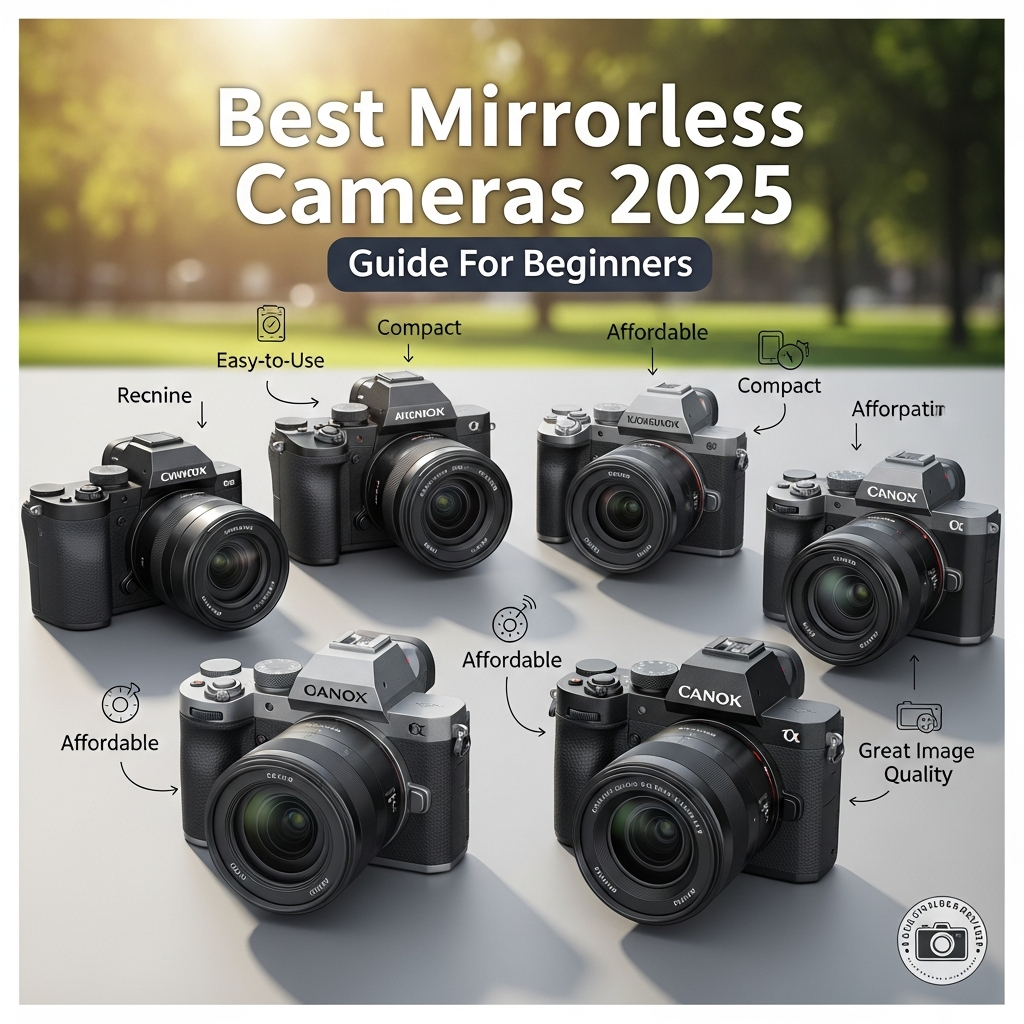
Top Picks: The Best Mirrorless Cameras 2025 for Beginners
Based on extensive testing and market trends, here are the top recommendations for those starting their journey this year.
1. Sony ZV-E10 II: Best for Content Creators
Sony has dominated the vlogging market, and the ZV-E10 II remains a top contender for 2025. It features a 26MP APS-C sensor and world-class autofocus. Its lack of an electronic viewfinder is compensated by its compact size and excellent built-in microphone.
2. Canon EOS R10: Best All-Rounder for Beginners
The Canon EOS R10 offers a perfect balance of ergonomics and performance. It feels like a traditional camera but packs a punch with 15 frames per second (fps) burst shooting. Canon’s menu system is widely regarded as the most intuitive for newcomers.
3. Fujifilm X-T50: Best for Aesthetics and Color
For those who value the “look” of their photos without heavy editing, the Fujifilm X-T50 is unmatched. It features dedicated Film Simulation dials that allow you to apply beautiful, analog-style filters to your images instantly. Its retro design is also a major draw for enthusiasts.
4. Nikon Z5: Best Affordable Full-Frame
If you are determined to start with a full-frame sensor, the Nikon Z5 is the most logical entry point in 2025. It offers dual SD card slots, a weather-sealed body, and access to Nikon’s exceptional Z-mount lenses at a price point that rivals many APS-C cameras.
Step-by-Step Guide: How to Choose Your First Camera
Selecting the right gear is a personal process. Follow these steps to ensure you make an informed investment:
Step 1: Define Your Primary Purpose
Are you shooting sports, portraits, or travel vlogs? If you need speed, prioritize autofocus and burst rates (Canon or Sony). If you want artistic control and portability, look at Fujifilm.
Step 2: Set a Realistic Budget
Remember that the camera body is only half the equation. You must also budget for lenses, memory cards, extra batteries, and a camera bag. Often, buying a slightly cheaper body and a better lens will yield better results than a high-end body with a “kit” lens.
Step 3: Test the Ergonomics
If possible, visit a local camera store. How does the camera feel in your hand? Are the buttons reachable? A camera that feels uncomfortable will likely end up gathering dust in a drawer.
Step 4: Check the Lens Ecosystem
When you buy a mirrorless camera, you are buying into a “system.” Sony currently has the widest selection of third-party lenses (Sigma, Tamron), which can save you significant money in the long run.
Essential Accessories for Your New Mirrorless Setup
To get the most out of your best mirrorless camera 2025, you will need a few key accessories:
- Fast SD Card: Look for UHS-II cards if you plan to shoot 4K video or high-speed bursts.
- Prime Lens: A 35mm or 50mm “Prime” lens (fixed focal length) usually offers a wider aperture (e.g., f/1.8), allowing for that professional-looking blurry background.
- Spare Batteries: Mirrorless cameras consume battery power faster than DSLRs because of the constant electronic display usage.
- Cleaning Kit: A simple blower and microfiber cloth are essential for keeping your sensor and lenses dust-free.
Expert Tips for Mastering Your Mirrorless Camera
Owning a great camera is only the first step; learning how to use it is where the magic happens. Here are three tips to accelerate your learning curve:
1. Master the Exposure Triangle: Understand the relationship between Aperture, Shutter Speed, and ISO. This is the foundation of all photography. Start in “Aperture Priority” mode to see how changing the f-stop affects your image.
2. Use the Histogram: Don’t just trust the screen brightness. Learn to read the histogram to ensure you aren’t “clipping” your highlights or losing detail in the shadows.
3. Shoot in RAW Format: Unlike JPEGs, RAW files contain all the data captured by the sensor. This gives you immense flexibility when editing your photos in software like Adobe Lightroom or Capture One.
Conclusion
The year 2025 is a phenomenal time to start photography. The best mirrorless cameras for beginners today offer features that were reserved for professionals just five years ago. Whether you choose the vlogging-centric Sony ZV-E10 II, the intuitive Canon EOS R10, or the stylish Fujifilm X-T50, you are investing in a tool that will help you see the world differently.
Your journey doesn’t end with the purchase. The most important thing is to take your camera with you everywhere, experiment with different settings, and most importantly, enjoy the creative process. Photography is a marathon, not a sprint, and the right mirrorless camera is your perfect companion for the road ahead.
Frequently Asked Questions (FAQ)
Is mirrorless better than DSLR for beginners in 2025?
Yes. Mirrorless cameras are generally more beginner-friendly because the electronic viewfinder allows you to see the effect of your settings in real-time. Additionally, the industry has shifted its focus to mirrorless, meaning better lens support and future-proofing.
Can I use my old DSLR lenses on a new mirrorless camera?
Yes, you can. Most manufacturers offer adapters (like the Canon EF-EOS R adapter or Nikon FTZ) that allow you to use older DSLR lenses on new mirrorless bodies with full autofocus functionality.
Do I need 4K video for photography?
While not necessary for still photos, having 4K video is highly recommended in 2025. It ensures your videos remain high-quality for modern screens and gives you more flexibility to “crop in” during editing without losing detail.
How much should a beginner spend on their first mirrorless camera?
A solid beginner setup (body + kit lens) typically ranges from $600 to $1,000. Spending less may result in missing key features like 4K video or decent autofocus, while spending more might lead to a complexity that is unnecessary for a novice.