Aesthetic Pencil Sketch Inspiration Guide For Beginners: Master the Art of Graphite
The allure of a pencil sketch lies in its simplicity and depth. For a beginner, staring at a blank piece of paper can be both exhilarating and intimidating. However, aesthetic pencil sketching is not merely about replicating reality; it is about capturing a mood, a texture, or a fleeting moment of beauty through the humble medium of graphite.
In this comprehensive guide, you will discover that anyone can create stunning art with the right mindset and techniques. Whether you wish to draw minimalist botanical illustrations or evocative portraits, this pillar content serves as your roadmap to mastering beginner sketching tips and finding your unique artistic voice.
Understanding the “Aesthetic” in Pencil Sketching
Before you sharpen your pencils, it is vital to understand what makes a sketch “aesthetic.” In the modern digital age, this term often refers to a specific visual harmony—clean lines, thoughtful use of negative space, and a balance between light and shadow. Aesthetic art evokes a feeling of peace, nostalgia, or wonder.
For you as a beginner, achieving an aesthetic look means focusing on creative drawing inspiration that prioritizes composition over complex details. It is about learning to see the world through a lens of simplified shapes and tonal values.
Essential Graphite Pencil Tools for Beginners
You do not need an expensive studio to start. However, using the right graphite pencil tools will significantly impact your progress. Standard office pencils are often too hard for artistic shading.
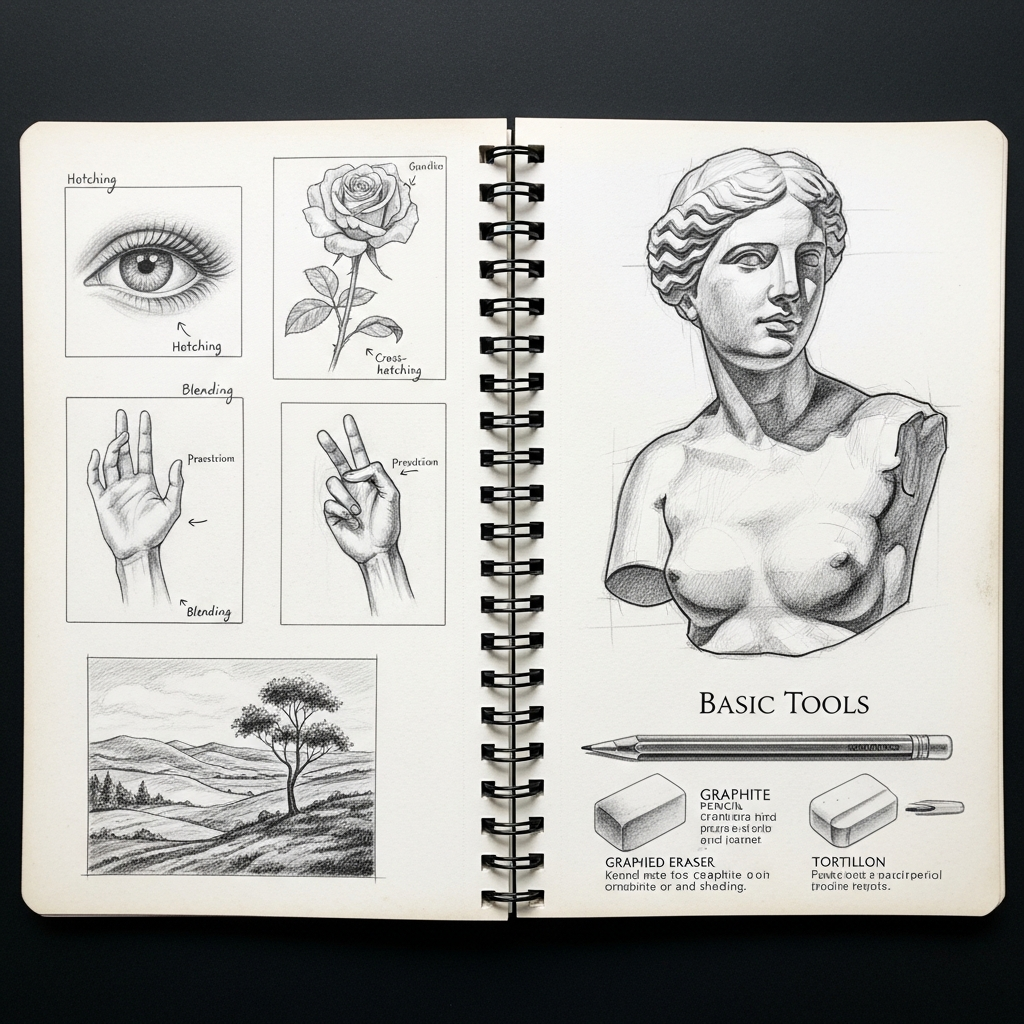
- The Grading System: Pencils range from H (Hard) to B (Black/Soft). For aesthetic pencil sketches, you should ideally have a 2H (for light outlines), an HB (for general work), and a 4B or 6B (for deep, rich shadows).
- Quality Sketchbook: Look for paper with a slight “tooth” or texture. This allows the graphite to grip the surface better, enabling smoother shading for beginners.
- Eraser Varieties: A vinyl eraser is good for complete removals, but a kneaded eraser is essential. You can mold it into points to lift highlights or soften dark areas without damaging the paper.
- Blending Stumps (Tortillons): These paper tools help you smudge graphite to create soft, misty textures—a hallmark of aesthetic art.
Fundamental Pencil Drawing Techniques
Success in sketching is built upon a foundation of sketching fundamentals. Before attempting complex scenes, you must practice how your hand moves across the page.
1. Mastering the Grip
Do not hold your pencil as if you are writing a letter. For sketching, hold it further back from the tip. This allows for more fluid, sweeping motions and prevents you from pressing too hard, which can leave permanent grooves in the paper.
2. The Power of Line Weight
An aesthetic sketch often uses varying line weights. A thin, light line can represent a distant horizon, while a thick, dark line brings an object to the foreground. Practice drawing lines that transition from light to dark in a single stroke.
3. Shading for Beginners: Creating Depth
Shading is what transforms a flat circle into a three-dimensional sphere. Focus on these three methods:
- Hatching: Drawing parallel lines close together.
- Cross-hatching: Layering parallel lines at different angles.
- Stippling: Using small dots to create texture and value.
Aesthetic Art Ideas to Kickstart Your Journey
Finding aesthetic art ideas is often the hardest part for a novice. Here are several categories of easy pencil sketches that yield high-impact results with minimal complexity.
Minimalist Botanical Sketches
Flowers and leaves are perfect for practicing organic shapes. Focus on a single sprig of eucalyptus or a delicate wildflower. Use light shading for beginners to give the petals volume without making them look heavy.
Celestial and Dreamy Themes
The moon, stars, and clouds are inherently aesthetic. Drawing a crescent moon with a few surrounding stars allows you to practice “negative space”—where the white of the paper becomes part of the art.
Architectural Details
Instead of drawing a whole house, focus on a single aesthetic window with a flower box or an ornate wooden door. This teaches you perspective and how to handle straight lines versus decorative flourishes.
The Human Element
Portraits are challenging, but you can start with “partial portraits.” A sketch of a single eye, a pair of hands holding a coffee cup, or the silhouette of a person looking at the sunset can be deeply evocative and less daunting than a full face.
Step-by-Step Guide: Drawing an Aesthetic Botanical Sprig
Follow this step-by-step detail to create your first aesthetic sketch. This exercise focuses on light and shadow in art.
Step 1: The Light Gesture
Using a 2H pencil, lightly draw a curved line for the stem. Don’t worry about perfection; organic shapes should look natural and slightly imperfect.
Step 2: Adding Basic Shapes
Sketch small ovals along the stem to represent leaves. Ensure they are spaced out to maintain a “minimalist” aesthetic look.
Step 3: Refining the Outlines
Switch to an HB pencil. Define the edges of the leaves. Add slight notches or curves to make them look realistic. Remember to vary your line weight—make the side of the leaf facing the “sun” lighter.
Step 4: Shading and Texture
Determine where your light source is coming from. Apply soft shading to the opposite side of each leaf using a 2B pencil. Use a blending stump to smooth the transition from dark to light.
Step 5: Final Highlights
Use your kneaded eraser to “tap” the center of the leaves, lifting a bit of graphite to create a highlight. This adds an instant professional touch to your aesthetic pencil sketch.
Understanding Light and Shadow in Art
The secret to aesthetic pencil sketch inspiration often lies in how you manipulate light. In the art world, this is known as Chiaroscuro. For beginners, you should focus on identifying the five elements of shading:
- Highlight: The brightest spot where light hits directly.
- Midtone: The actual color/value of the object.
- Core Shadow: The darkest part of the object itself.
- Reflected Light: A small strip of light at the very edge of the shadow side.
- Cast Shadow: The shadow the object throws onto the surface it is sitting on.
By including all five elements, your sketches will pop off the page with a 3D effect that looks sophisticated and intentional.
Expert Tips for a Professional Finish
Even as a beginner, you can use tips from experts to elevate your work instantly:
- Keep Your Hands Clean: Place a piece of scrap paper under your hand while drawing. This prevents your palm from smudging your finished work.
- Sharpen Frequently: A dull pencil leads to muddy drawings. For fine details in portrait sketching for beginners, a sharp point is non-negotiable.
- Don’t Overwork It: Sometimes, knowing when to stop is the most important skill. Aesthetic art often thrives on simplicity. If the sketch feels “done,” it probably is.
- Use a Fixative: Once finished, spray your sketch with a professional fixative (or a light mist of hairspray in a pinch) to prevent the graphite from shifting over time.
How to Find Creative Drawing Inspiration
When you feel stuck, look beyond the sketchbook. Creative drawing inspiration can be found in:
- Nature: The veins in a leaf or the texture of tree bark.
- Photography: Look at black and white photos to understand tonal values without the distraction of color.
- Daily Life: The way shadows fall across your morning toast or the folds in your bedsheets.
Frequently Asked Questions (FAQ)
What is the best pencil for a beginner to start with?
If you only buy one, choose an HB pencil. However, a small set containing 2H, HB, 2B, and 4B is ideal for achieving a full range of aesthetic values.
How do I stop my sketches from looking “messy”?
Messiness usually comes from unintentional smudging. Use a rest-sheet under your hand and focus on making clean, deliberate lines rather than “petting” the paper with short, hairy strokes.
Can I learn to sketch if I have no natural talent?
Absolutely. Sketching is a mechanical skill that involves eye-hand coordination. Like any muscle, it grows stronger with regular practice and the right sketching fundamentals.
How long does it take to get good at pencil sketching?
You will see significant improvement in just 30 days if you practice for 15-20 minutes daily. Consistency is more important than long, infrequent sessions.
Conclusion: Your Journey into Aesthetic Art
Starting your journey with aesthetic pencil sketch inspiration is a rewarding endeavor that allows you to slow down and appreciate the details of the world. By mastering graphite pencil tools, understanding light and shadow in art, and practicing beginner sketching tips, you are well on your way to creating beautiful works of art.
Remember, every expert was once a beginner. Do not be afraid to make mistakes; every “bad” drawing is simply a stepping stone toward your masterpiece. Grab your pencil, find a quiet corner, and start sketching your aesthetic vision today.