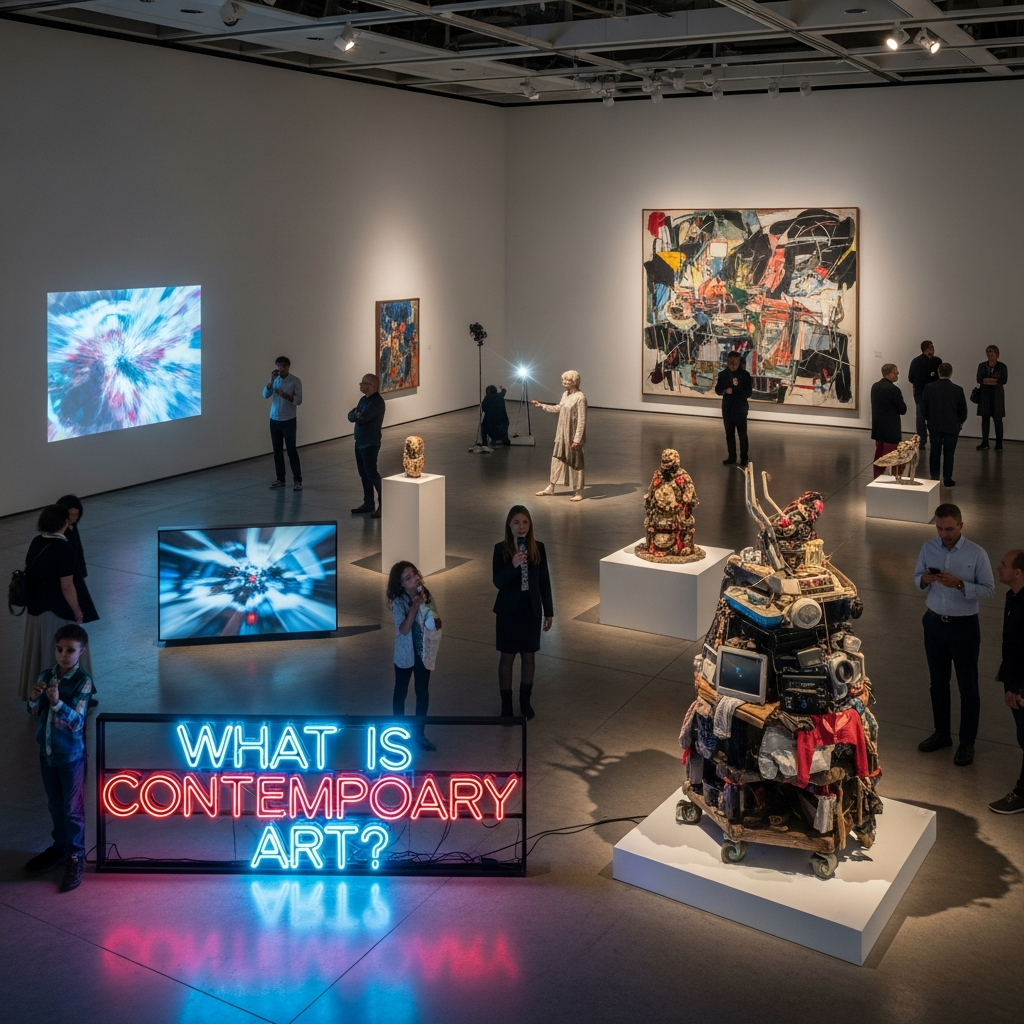
If you have ever walked into a gallery and been confronted by a massive sculpture of a balloon dog, a video installation, or a simple stack of bricks, you might have paused and asked a fundamental question: What Is Contemporary Art? The definition is not fixed, but generally speaking, contemporary art refers to art produced from the late 20th century—specifically from the 1970s or 1980s—up to the present day. It is a dynamic, fluid, and often challenging body of work that emphasizes ideas, social commentary, and a vast diversity of media beyond traditional painting and sculpture. It reflects the globalized, technology-driven world we live in today.

Defining the Undefinable: What Is Contemporary Art?
For many people, the term “contemporary art” feels intimidating or confusing, primarily because it lacks the clean historical boundaries of movements like Impressionism or Cubism. In essence, it is the art of our time; it is the visual language currently being developed and consumed globally. But the question, What Is Contemporary Art, demands a deeper look than just a timeline. It is fundamentally about the artist’s relationship to the present moment.
It is important to understand the distinction between “Modern” and “Contemporary” to fully grasp What Is Contemporary Art. Modern art, which spanned roughly from the 1860s to the 1970s, was characterized by a rejection of tradition and an exploration of abstract form and material. Contemporary art, however, tends to move past the obsession with form itself and focus on context, content, and the audience’s interaction. Where Modernism asked, “What can art be?” Contemporary art often asks, “What does art mean in this specific cultural moment?” This shift from formalist experimentation to conceptual engagement is a hallmark of What Is Contemporary Art.
The core difficulty in answering What Is Contemporary Art stems from its heterogeneity. There is no single style, technique, or philosophy that unites all contemporary artists. Instead, it is a vast, interconnected network of diverse voices, mediums, and political perspectives. This pluralism means that a hyperrealistic portrait, a massive installation made of recycled trash, and a performance piece exploring gender identity can all comfortably fall under the same umbrella. The unifying factor is the timeliness and the artist’s engagement with current, often pressing, issues.
The Elusive Timeline: Where Does the “Contemporary” Start?
While the most common starting point for contemporary art is generally cited as the end of the Pop Art movement or the rise of Conceptualism in the late 1960s and early 1970s, the precise date is highly debated by historians. Many scholars and institutions mark 1970 as a convenient, albeit arbitrary, break, signifying the moment when the formal concerns of Modernism finally gave way to a focus on concept and context. This period saw a dramatic rise in new media and non-traditional art forms, reshaping the answer to What Is Contemporary Art.
The shift was not sudden, but rather a gradual evolution marked by key cultural moments. The breakdown of traditional hierarchies in painting and sculpture, the influence of feminist and civil rights movements, and the rapid globalization of the art world all played a role. For example, artists in the 1980s began directly addressing issues of consumerism, AIDS, and identity politics, cementing the idea that the purpose of art could be direct social commentary rather than purely aesthetic contemplation. This change made the resulting works vastly different from their Modern predecessors, offering a tangible marker for when the definition of What Is Contemporary Art truly took hold.
Another way to think about the timeline is in terms of generational impact. Every generation of artists grappling with the present is technically creating contemporary art, but the term, as a historical movement, refers specifically to those working after the dominant institutions and styles of Modernism faded. Therefore, while it is chronologically defined by time, the true boundary for What Is Contemporary Art is more accurately defined by a fundamental conceptual break from the past, prioritizing the idea behind the artwork over the craftsmanship of its execution.
Characteristics That Set It Apart
When trying to understand What Is Contemporary Art, focusing on its characteristics is often more helpful than relying solely on dates. The nature of this art is generally defined by several key attributes that consistently appear in galleries and museums today. These attributes reflect a world increasingly connected, challenged, and saturated with information, making it clear that contemporary works serve as a mirror to our complicated reality.
Key Characteristics of Contemporary Art include:
- Diversity of Medium: Contemporary artists use everything from traditional paint and canvas to digital video, virtual reality, genetics, and even live performance. The medium is chosen to serve the concept, not the other way around.
Conceptual Focus: The idea* or concept behind the work is often considered more important than the finished object or the artist’s skill in traditional craft. Understanding the artist’s intent is crucial to appreciating What Is Contemporary Art.
- Social & Political Engagement: Much of contemporary work directly addresses current societal issues, including globalization, identity, technology, environmental sustainability, and consumer culture. It is frequently challenging and sometimes deliberately provocative.
- Interactivity and Experience: Many contemporary works are installations designed to immerse the viewer, or participatory pieces that require the audience’s involvement to be complete. The experience of the art becomes the art itself.
This focus on experience is a critical part of the answer to What Is Contemporary Art. Unlike viewing a Renaissance masterpiece, where the viewer is an admirer of a distant work, contemporary works often pull the viewer into the frame. For instance, an immersive installation by Yayoi Kusama or a large-scale land art piece requires the viewer to physically navigate the work, turning passive observation into active participation. This emphasis on the viewer’s subjective experience ensures that the meaning of the work is co-created in the moment.
Ultimately, the most defining characteristic of What Is Contemporary Art is its refusal to be categorized. It is a movement defined by its lack of a singular style. It is an acknowledgment that in a globalized world, art can and should speak in a thousand different voices, using whatever tool is necessary to communicate the artist’s complex message about our shared, turbulent world.
The Conceptual Playground of Contemporary Art
One of the greatest challenges and rewards in engaging with contemporary works is recognizing that the traditional boundaries of what constitutes “art” have been thoroughly dismantled. To truly appreciate What Is Contemporary Art, one must be willing to accept that the idea is often the artwork itself, and the physical object is simply its manifestation—or, sometimes, not even present at all.
This reliance on concept began with earlier movements but became fully realized in the contemporary era. Conceptual artists argue that if the power of a piece resides in its underlying idea, then the meticulous craftsmanship of a traditional work becomes secondary. This philosophy liberated artists from the constraints of painting and sculpture, allowing them to utilize ephemeral forms like performance, documentation, and unconventional materials. This shift is central to understanding the evolution of What Is Contemporary Art.
For example, consider the difference between a bronze statue from the Modern era and a video loop by a contemporary artist. The statue’s value lies partly in its material permanence and the skill required to mold the metal. The video loop, however, is transient, reproducible, and technologically dependent; its value resides almost entirely in the message, the moment, or the unique perspective it offers. This willingness to embrace impermanence and non-traditional value systems is a powerful element of What Is Contemporary Art.
Beyond the Canvas: A Media Revolution
The media revolution is perhaps the most visible indicator of What Is Contemporary Art. The field exploded past the confines of oil and marble with the advent of accessible technology. This expansion was not just about using new tools but about fundamentally challenging the notion of artistic permanence and uniqueness.
Non-Traditional Media Common in Contemporary Works:
- Installation Art: Large-scale, site-specific constructions designed to transform the perception of a space. These pieces are often temporary and engage all the viewer’s senses.
- Performance Art: Art that uses the human body and live action as the medium. It is often non-repeatable, relying on documentation (photography, video) for its lasting record.
- Video and Film: From single-channel projections to multi-screen immersive experiences, video allows contemporary artists to manipulate time, narrative, and sound in complex ways.
Found Objects (Assemblage): The use of everyday, mass-produced, or discarded items (called readymades* in earlier iterations) to create sculptures or installations. The context, not the material value, gives the object new meaning in What Is Contemporary Art.
This embrace of technology and unconventional materials fundamentally democratized the art-making process, allowing artists to create statements that are far more immediate and relevant to the current socio-political environment. The accessibility of digital tools means that a powerful piece of What Is Contemporary Art can be created on a laptop and shared globally within minutes, creating a rapid feedback loop between the creator and the global audience that was impossible just a few decades ago.
The Primacy of Idea Over Execution
The phrase “The idea is the machine that makes the art” perfectly encapsulates the core philosophy driving What Is Contemporary Art. This prioritization of the concept can be frustrating for those who value traditional skill, but it is necessary to interpret many contemporary works accurately. If the concept is king, then the role of the artist shifts from being a master craftsman to being a sophisticated thinker or cultural commentator.
In the context of What Is Contemporary Art, the process of creation often involves delegation. An artist like Jeff Koons, for example, is famous for producing high-finish, massive sculptures that are physically executed by a large team of professional fabricators. His job is not the physical painting or sculpting; his job is the conceptualization, the vision, and the decision-making. The artwork’s meaning is embedded not in the brushstrokes, but in the conceptual choices—the scale, the material (like highly polished stainless steel), and the subject matter (like consumer products or children’s toys).
This shift requires the audience to change their viewing habits. Instead of looking for beauty, harmony, or technical brilliance, viewers are asked to look for relevance, commentary, and provocation. When encountering a piece of What Is Contemporary Art, the first questions should not be “Is it beautiful?” but rather, “What is the artist trying to say?” and “Why did the artist choose this material and this presentation?” Understanding the artist’s intent and the cultural context is the key to unlocking the power of the piece.
Current Trends and Movements in Contemporary Art
The constant evolution is what makes the definition of What Is Contemporary Art perpetually challenging and exciting. The field does not stand still; it moves at the speed of culture, technology, and global politics. The most dominant current trends reflect an increasing awareness of global interconnectivity, environmental urgency, and the impact of digital life.
One striking trend is the increasing focus on previously marginalized voices. The global contemporary art market, and the museums that shape its narrative, have been making concerted efforts to showcase artists from the Global South, female artists, and artists of color. This institutional shift is correcting decades of historical underrepresentation, bringing new perspectives and radically different narratives to the forefront of What Is Contemporary Art. This focus is transforming exhibition programming and permanently broadening the scope of what is considered essential contemporary work.
Digital Frontiers: The Rise of Generative and Crypto Art
The most disruptive recent development in the sphere of What Is Contemporary Art is the embrace of digital frontiers, most notably through non-fungible tokens (NFTs) and generative art. While digital art has been around for decades, the technology enabling verifiable digital ownership and algorithmic creation has created an entirely new market and artistic movement.
NFTs have fundamentally challenged the long-held concept of scarcity in art. Since digital images can be infinitely copied, the NFT provides a unique digital certificate of ownership, allowing digital artists to finally sell singular, high-value works. This has led to massive, record-breaking sales and an explosion of artists experimenting with blockchain technology. This new financial model has created an urgent, new chapter in the discussion around What Is Contemporary Art.
Key Aspects of Digital Contemporary Art:
Generative Systems: Artists design code or rulesets (algorithms) which then create unique visual outputs. The art is the process and the system*, not just the final image.
- Virtual Reality (VR) and Augmented Reality (AR): These tools allow artists to create immersive worlds that break physical boundaries. The artwork exists solely in a digital space, requiring specialized equipment for viewing.
- Data Visualization Art: Using massive datasets (social media trends, climate data) as the raw material for visual art, turning abstract information into aesthetic, readable forms of What Is Contemporary Art.
The rise of these digital forms forces us to reconsider value and authenticity. If an artwork is just code, or if it changes every time it is viewed (as in generative art), how do we critique it? These are the complex, modern questions that constantly redefine What Is Contemporary Art, linking it intrinsically to the cutting edge of technological development and global markets.
Art as Activism: Addressing Social and Political Climate
A significant portion of What Is Contemporary Art functions as a tool for social and political activism, directly engaging with the current global climate. Artists often use their platforms to critique systems of power, raise awareness about human rights issues, and memorialize marginalized communities. This role as a cultural critic highlights art’s enduring capacity to provoke thought and inspire change.
This artistic activism is evident in works that tackle environmental decay, for example. Artists create large-scale installations using plastic debris recovered from the ocean or incorporate living, decaying matter into their work to force viewers to confront the reality of climate catastrophe. The scale and material choice serve a didactic purpose, turning the act of viewing into an educational and ethical confrontation. This kind of powerful, urgent statement is often at the heart of What Is Contemporary Art.
Furthermore, many contemporary artists are focused on exploring complex issues of identity, including race, gender, and sexuality, transforming personal narratives into universal commentary. By sharing deeply personal stories and cultural histories through media ranging from photography to textile art, these artists challenge dominant historical narratives and contribute to a more inclusive cultural record. This focus on lived experience and challenging entrenched power structures is a vibrant, driving force within the world of What Is Contemporary Art.
The Interactive Experience: Participatory Art
Another defining trend in the current scene is the move towards participatory or relational art, where the artwork is incomplete without the action or presence of the audience. The intent of this approach is to break down the barrier between the creator, the object, and the viewer, making the artwork a shared experience or a social experiment. This concept profoundly alters the traditional viewing dynamic and deepens the understanding of What Is Contemporary Art.
In a participatory piece, the artist might provide materials and a set of instructions, and the audience’s completion of the task is the artwork. This could involve writing notes on a wall, arranging objects, or even engaging in dialogue with the artist or other participants. The temporary, communal nature of these works contrasts sharply with the permanent, individual nature of traditional painting, offering a fresh answer to the question, What Is Contemporary Art?
The power of participatory art lies in its ability to foster community and dialogue. By forcing interaction, the art becomes a catalyst for social engagement rather than a static object of admiration. This method reinforces the contemporary art world’s belief that art is a living, breathing entity that changes based on its context and its consumers. The documentation of the interaction—the photographs, videos, and written accounts—often become the lasting, historical records of the completed, momentary piece of What Is Contemporary Art.

Market Dynamics and the Contemporary Art World
The perception of What Is Contemporary Art is often inextricably linked to the staggering sums of money exchanged in the global market. While the conceptual power of the art remains paramount, the financial value has created a complex ecosystem of collectors, dealers, auction houses, and museums that collectively dictate the prevailing narrative of contemporary works.
The global art market is an influential, multi-billion-dollar industry, and the contemporary sector is consistently one of its most lucrative and volatile segments. High-profile auction sales often dominate headlines, turning certain artists into global commodities. These sales not only grant financial value but also bestow cultural validation, cementing which works and artists will be preserved and studied in the future. The dynamics of the market, therefore, play a massive, if controversial, role in defining What Is Contemporary Art.
The contemporary art market, more so than other art sectors, is fueled by global wealth and speculative investment. Younger collectors, often from technology or finance backgrounds, are increasingly interested in contemporary works because they are seen as relevant, challenging, and possessing high investment potential. This influx of new money and new perspectives helps to drive the continuous, high-speed turnover of artistic trends, ensuring that the answer to What Is Contemporary Art is constantly being updated by market forces.
Auction House Records and the Billion-Dollar Industry
The contemporary art sector is marked by astonishing auction results that capture global attention. These high-value transactions—often reaching tens or hundreds of millions of dollars—underscore the status of certain contemporary artists as global icons. For instance, works by artists like Jeff Koons and Basquiat consistently break records, making them proxies for investment and cultural currency. These sales are critical data points in understanding the financial weight behind the discussion of What Is Contemporary Art.
However, the auction house environment presents a highly curated, often narrow view of What Is Contemporary Art. The pieces that command the highest prices are typically those that are visually striking, easily transportable, and produced by artists with established—and often Western-centric—careers. This financial focus can overshadow the more challenging, less commercially viable forms of contemporary work, such as ephemeral performance art or massive, site-specific installations, which, though often conceptually powerful, are difficult to sell or collect.
The industry also relies heavily on specialized contemporary art fairs (like Art Basel or Frieze), which act as temporary marketplaces for the global elite. These fairs are key drivers of trends, setting the tone for what collectors and institutions will acquire in the coming years. Attending these fairs provides a snapshot of the current state of What Is Contemporary Art, showcasing everything from established masters to emerging artists in highly commercialized environments.
The Institutional Shift: Museums and Inclusivity
While the market focuses on high-value sales, museums and large cultural institutions are grappling with the historical narrative of What Is Contemporary Art. There has been a significant and necessary institutional shift in recent years toward greater inclusivity and global representation. Museums are actively acquiring works from regions and artists that were historically overlooked, especially from Africa, Asia, and Latin America.
This institutional commitment is driven by a recognition that the narrative of What Is Contemporary Art must reflect the true global diversity of artists working today. By dedicating resources to showcasing artists who explore non-Western philosophies, cultural histories, and post-colonial critiques, institutions are radically revising the canon. This broadening of perspective ensures that contemporary works are not viewed solely through a Western lens but as part of a complex, global dialogue.
This push for inclusivity directly challenges the historical definition of What Is Contemporary Art, forcing the field to confront its own biases. It involves collecting and exhibiting media that might not fit traditional conservation standards, such as textiles, community-based crafts, or indigenous practices, recognizing their validity as contemporary art forms. This dedication to comprehensive representation is shaping the museums of tomorrow, ensuring a richer, more accurate historical record of What Is Contemporary Art for future generations.
Prominent Voices: Case Studies in Contemporary Art
To move the discussion beyond abstract definitions, it is helpful to look at specific artists whose careers embody the diverse and challenging nature of What Is Contemporary Art. These individuals use different media, philosophies, and approaches, yet they all share a common thread: they engage deeply with the present moment and redefine the possibilities of art.
Yayoi Kusama: The Immersive Infinity
Yayoi Kusama, a Japanese artist whose career began in the 1960s but whose global recognition has exploded in the contemporary era, provides a perfect case study in the power of immersive and experiential What Is Contemporary Art. Her work is immediately recognizable for its use of polka dots, nets, and mirrored environments, which she uses to express her internal psychological states.
Kusama’s famed Infinity Mirror Rooms are perhaps the most popular example of contemporary installation art. These rooms use carefully placed mirrors and lights to create the illusion of endless space, inviting viewers to step inside a seemingly infinite cosmos. The experience is both individual and widely shared on social media, making her work perfectly positioned within the modern cultural landscape. The essence of this work lies not in the physical structure itself, but in the psychological effect of the boundless, repeatable experience it creates. This fusion of personal vision and audience participation is a powerful illustration of What Is Contemporary Art.
The success of Kusama’s work demonstrates how What Is Contemporary Art can be both profoundly personal and universally appealing. Her artistic process is a means of coping with deep personal anxiety, yet the resulting installations offer a beautiful, contemplative escape for millions of viewers. This ability to transform profound psychological experience into a communal aesthetic phenomenon highlights the depth and reach of her contribution to What Is Contemporary Art.
Banksy: The Anonymous Commentary
The street artist known as Banksy offers a completely different, yet equally defining, answer to What Is Contemporary Art. Working primarily in public spaces, often illegally, Banksy uses stencil graffiti to create potent political and social commentary that is accessible to everyone, not just those who visit museums. His work is intrinsically tied to its location, addressing issues like anti-consumerism, war, and political corruption with sharp wit and immediate visual impact.
Banksy’s practice exemplifies how What Is Contemporary Art can exist outside of traditional market structures, although his works are now highly valuable and frequently removed from walls and sold at auction. The act of placing a provocative image in a public space—a wall in Gaza, a subway car in London—turns that location into a temporary gallery, forcing the public to confront the art in their daily lives. The anonymity of the artist adds a layer of conceptual intrigue, focusing the attention entirely on the message rather than the personality of the creator.
His famous act of shredding his Girl with Balloon painting immediately after it sold for over a million dollars at a public auction is a defining moment in recent What Is Contemporary Art history. This performance piece was a direct commentary on the commodification of art, forcing collectors and the public to question the very nature of artistic value and market hysteria. This willingness to use the art object and the market itself as the medium for critique makes Banksy a crucial figure in the definition of What Is Contemporary Art.
Jeff Koons: The Reflection of Popular Culture
Jeff Koons is often seen as the ultimate practitioner of What Is Contemporary Art that engages with high-low culture. Known for his gigantic, mirror-polished stainless steel sculptures of balloon animals, children’s toys, and other kitsch objects, Koons forces a dialogue about taste, celebrity, and consumerism. His work is visually stunning, technically impeccable (though fabricated by others), and undeniably controversial.
Koons’s work challenges the historical hierarchy that separates ‘fine art’ from ‘mass culture.’ By taking a cheap, disposable object like a balloon animal and transforming it into a massive, meticulously crafted monument of incredible value, he questions where art finds its meaning in a consumer society. Is the value in the labor, the material, or the concept of glorifying the mundane? The answer to What Is Contemporary Art, in Koons’s universe, is a mirror reflecting the desires and obsessions of the wealthy, consumer-driven global culture.
His pieces are often described as ‘empty’ or purely commercial, but this very critique is part of the art. Koons’s intention is often to remove the hand of the artist and the weight of historical commentary, presenting objects that are pure, pristine, and simply present. This refusal to yield to heavy intellectual interpretation, instead offering a polished surface that reflects the viewer and the surrounding gallery, makes his work a fascinating and often frustrating benchmark for understanding What Is Contemporary Art.
What Is Contemporary Art: More Than Just a Timeframe
Ultimately, answering the question, What Is Contemporary Art, requires moving past simple chronological boundaries. It is not just the art created today; it is a mindset, a way of engaging with the world, and a reflection of our collective global consciousness. It is the art that forces us to pause, to question our assumptions, and to reconsider the boundaries of creativity itself.
The common threads that tie together the vast array of works falling under this umbrella—from performance pieces and digital installations to large-scale sculptures and activist street art—are relevance and dialogue. Contemporary artists are those who feel a deep responsibility to respond to the pressures, technologies, and moral dilemmas of their specific time. They are cultural interpreters, using unconventional tools to initiate conversations that are often uncomfortable but always essential. This commitment to the current moment is the very soul of What Is Contemporary Art.
To fully appreciate What Is Contemporary Art, viewers must approach it with an open mind, ready to engage conceptually rather than just aesthetically. It requires an acknowledgment that the most important work may not be the most beautiful, but the most challenging, the most timely, or the most disruptive. By embracing this complexity and accepting its endless, evolving definitions, we gain a clearer view not only of the art itself but also of the dynamic, ever-changing culture that shapes it. The conversation around What Is Contemporary Art is ongoing, and that constant state of flux is what makes it so vital and compelling.
*
FAQ (Frequently Asked Questions)
## What is the difference between Modern Art and Contemporary Art?
Modern Art generally spans the period from the 1860s to the 1970s and is characterized by a formal rejection of tradition, focusing primarily on abstract form, color, and material experimentation (e.g., Cubism, Abstract Expressionism). Contemporary Art (1970s/1980s to the present) moves beyond formal concerns and prioritizes the concept and context of the work. Contemporary works often use new media, engage in social commentary, and seek to involve the audience directly, fundamentally changing the answer to What Is Contemporary Art.
## Why is contemporary art often so controversial or hard to understand?
Contemporary art can be controversial or difficult to understand because its value lies primarily in the idea rather than the technical skill or aesthetic beauty. Artists often use shock, unusual materials, or complex social theories to provoke thought or critique society. It challenges traditional notions of beauty and craftsmanship, requiring the audience to engage with the artist’s conceptual statement and cultural critique to fully grasp What Is Contemporary Art.
## What materials are used in Contemporary Art?
The materials used in contemporary art are virtually limitless, extending far beyond the traditional canvas and marble. Contemporary artists frequently utilize:
- Non-traditional objects (Found objects, mass-produced items, recycled materials)
- Time-based media (Video, film, performance, sound installations)
- Digital technology (Virtual reality, augmented reality, generative coding, NFTs)
- Ephemeral materials (Light, water, live plants, human interaction)
The choice of material is crucial because it is almost always chosen to reinforce the concept of the piece, which is a defining element of What Is Contemporary Art.
## Is Pop Art considered Contemporary Art?
Pop Art, which flourished mainly in the 1950s and 1960s, is generally considered the last major movement of Modern Art, or sometimes a transitional movement that bridged the gap between Modern and Contemporary. While its influence on subsequent generations is massive—especially its use of consumer culture and mass media imagery—the Contemporary Art period proper is usually dated as beginning after Pop Art’s peak influence waned in the early 1970s.
## What are some of the dominant themes explored in Contemporary Art?
Contemporary artists explore themes that reflect the current global environment. Some of the most dominant themes that define What Is Contemporary Art include:
- Globalization and Cultural Identity
- Environmental Sustainability and Climate Change
- Technology and the Digital Experience
- Social Justice, Race, and Gender Equality
- Consumerism and Capitalism
These themes ensure that the art remains relevant and acts as a cultural mirror to the contemporary world.